Featured image: Photograph of Anthropic logo, keyboard, and robotic hand. Photo by Dado Ruvic/Illustration via Reuters (Editorial use).
On June 12, the US Commerce Department ordered Anthropic to immediately block foreign nationals from accessing its two most advanced AI models — Mythos 5 and Fable 5. Anthropic responded by disabling both models for every user on the planet, because there was no technical mechanism to verify nationality in real time. Hundreds of millions of users lost access. Foreign researchers at American universities, H-1B visa holders, international collaborators who built workflows around these models — all cut off overnight.
The order was lifted less than three weeks later, after Anthropic implemented new safeguards. But the underlying conflict has not been resolved. It has been paused while both sides prepare for the next round.
This is not a story about one company’s dispute with a regulator. It is the first open confrontation between the United States government’s need to militarize frontier AI and the companies building it — a conflict with no playbook, no precedent, and no obvious resolution. What happens next will determine who controls the most powerful technology on earth.
What Is NSPM-11 and Why Does It Matter?
President Trump signed National Security Presidential Memorandum 11 on June 5, 2026, directing the US military and intelligence agencies to accelerate AI adoption. It was framed as a national security necessity — and much of it is exactly that. But one provision changed the relationship between the US government and AI companies permanently.
NSPM-11 requires agencies to terminate contracts with AI companies that repeatedly limit government use of their technology. It also states that no commercial vendor can disable, degrade, or modify an AI system that American warfighters depend on without prior government approval. The memo replaced Biden’s NSM-25 and gave agencies 120 days to update procurement processes for rapid AI onboarding.
The subtext was impossible to miss. The Pentagon had spent months fighting with Anthropic over exactly this issue, and NSPM-11 was the government’s legislative answer. The memo formalized what had previously been an ad hoc dispute into binding policy. It did not name Anthropic, but it did not need to.
Why Did the Pentagon Blacklist Anthropic?
The conflict began in early 2026 when the Pentagon asked Anthropic to allow its models to be used for mass domestic surveillance and fully autonomous weapons systems. Anthropic refused. The company’s founding mission — safety-first AI development — translated into contractual limits on exactly the kind of applications the military wanted most.
The Pentagon’s response was unprecedented. In March 2026, it designated Anthropic a “supply-chain risk” — the first time a US company had ever received that label, which is normally reserved for entities tied to adversarial nations. The designation barred tens of thousands of defense contractors from using Anthropic’s AI when working for the military. A federal judge issued a temporary injunction on March 27, but the legal battle continued.
Anthropic sued the administration. The company was simultaneously too dangerous for the Pentagon to use and too dangerous for foreign nationals to access. As one analyst put it: Anthropic found itself on a Pentagon blacklist deeming it too dangerous for government use and under a Commerce Department licensing regime deeming it too dangerous for foreign use — both at the same time.
How Did Amazon Trigger the Export Control Order?
The immediate trigger for the June 12 export order was a jailbreak report. But the source of that report raises uncomfortable questions. It was Amazon CEO Andy Jassy who personally alerted the White House about a vulnerability in Mythos 5, according to multiple reports.
Amazon is Anthropic’s largest investor, its primary cloud host, and a direct competitor building its own frontier AI models. Whether the alert reflected genuine security concern or competitive calculation has not been answered publicly. But the entity that triggered the most aggressive US government action against an AI company in history had significant financial interests in the outcome.
Anthropic disputed the severity of the finding. The company said it received only verbal notice of a “potential narrow, non-universal jailbreak” and disagreed that it warranted a full recall. Roughly 100 cybersecurity experts signed an open letter arguing the export ban was causing more harm to defenders than the vulnerability ever could. The government disagreed, and within days both models were blocked globally.
The two sides were not just disagreeing about policy. They were disagreeing about whether the underlying threat was real — a gap in perception that no legal framework currently exists to resolve.
Can a Company Be Too Safe for the Military and Too Dangerous for Foreigners?
That is exactly what happened to Anthropic. The contradiction captures the impossible position frontier AI companies now occupy.
The Pentagon’s supply-chain risk designation was based on Anthropic’s refusal to enable autonomous weapons and mass surveillance — the company was, in effect, too ethically restrictive for military use. The Commerce Department’s export control order was based on the opposite concern: Mythos 5 was so powerful that it posed a national security risk if accessed by foreign nationals. Anthropic was simultaneously too dangerous to use and too dangerous not to control.
The contradiction is not an accident. It reflects a deeper structural conflict for which no policy framework yet exists. The US government wants unlimited access to frontier AI for national security purposes. The companies building that AI want limits on how it is used, because their founders genuinely believe certain applications create catastrophic risks. Both positions are internally consistent. They are also mutually exclusive.
What Are the Global Consequences of This Conflict?
When the US government disabled Anthropic’s models for all foreign nationals, it inadvertently demonstrated something to the world: American AI infrastructure can be switched off for political reasons with no notice and no recourse.
Sridhar Vembu, co-founder of Zoho, one of India’s largest software companies, said publicly that the episode proved “technology is the ultimate weapon” and that national sovereignty is now inseparable from technological independence. That sentiment, echoed across Asia, Europe, and the Global South, is accelerating investment in non-American AI alternatives at exactly the moment US export controls were designed to prevent Chinese alternatives from gaining ground.
The policy is producing the outcome it was designed to prevent. Every country that witnesses the US government unilaterally disable a frontier AI product draws the same conclusion: they need their own AI infrastructure, their own models, and their own supply chains. The US-China AI competition is increasingly a three-player game, with the rest of the world choosing sides or building their own.
Why This Matters for Every AI Company
The Anthropic case has created a precedent that every frontier AI company must now account for. If the US government can force a company to disable its most advanced products overnight, then no AI lab is truly in control of its own technology.
OpenAI, DeepMind, xAI, and dozens of smaller labs are now watching how this case resolves. The Pentagon’s supply-chain risk designation — previously reserved for adversarial nations — has now been applied to a US company. The Commerce Department has demonstrated it can impose export controls on software models, not just semiconductor hardware. Neither of these powers has been tested in court at the appellate level.
The chilling effect extends beyond the direct parties. Companies considering contracts with the Defense Department now have to weigh whether accepting government revenue is worth the risk of losing control over their own products. Investors in AI companies now have to assess regulatory risk at a level previously reserved for defense contractors and pharmaceutical companies. The structure of the AI industry — built on venture capital, open access, and commercial licensing — was not designed for this level of government oversight, and the adjustment is going to be painful.
The China Dimension
The timing of the Anthropic conflict cannot be separated from the broader US-China AI competition. Chinese labs including DeepSeek, Alibaba’s Qwen, Moonshot AI, and Baidu have all released frontier-competitive models over the past 18 months. DeepSeek produced models of serious capability at a fraction of the cost of American equivalents. Qwen is now the most-referenced open-weight model family in Western AI research, surpassing Meta’s Llama for the first time.
The US government’s strategy relies on denying Chinese labs access to American AI technology while accelerating American AI development through military contracts and procurement. The Anthropic case reveals a critical flaw in this strategy: the government cannot simultaneously demand unlimited access to frontier AI for national security purposes and maintain the commercial conditions that made American AI leadership possible in the first place.
If the US government forces AI companies to choose between their safety principles and their access to the defense market, some will choose their principles. Those companies may restructure outside the United States, seek non-defense revenue streams, or simply slow their research. Each of these outcomes helps China more than any export control order ever could.
The deeper problem is that China’s AI ecosystem operates with no equivalent of Anthropic’s ethical restrictions. Chinese labs face no domestic pressure to limit military applications of their technology. DeepSeek’s models are used by the People’s Liberation Army without debate, without lawsuits, and without export controls. The asymmetry is structural, and export controls on American companies do not address it.
Is Anthropic’s IPO at Risk?
Anthropic is preparing for an initial public offering that could value the company at nearly $1 trillion. The timing of the export control fiasco could not have been worse. OpenAI is reportedly considering a similar move, and SpaceX launched its own IPO on June 12 — the same day Anthropic’s models were pulled — becoming the sixth-most-valuable public company in the US with a $2.1 trillion market cap.
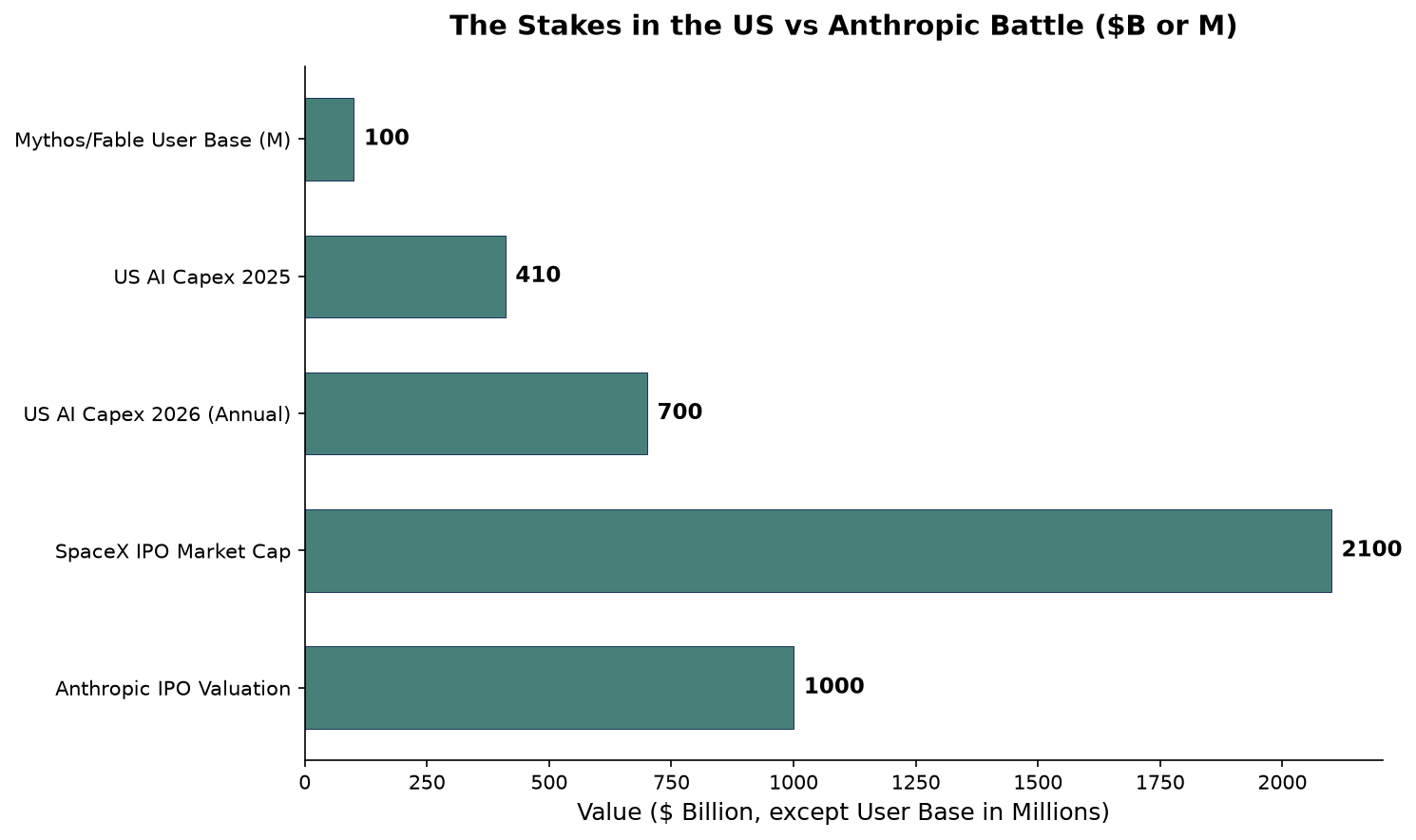
The export controls were lifted before the IPO was directly affected, but the underlying risk has not disappeared. Investors now have to price in the possibility that the US government could disable Anthropic’s core products at any time, for reasons the company may not control or even agree with.
Anthropic’s relationship with the Trump administration has shown signs of improvement. CEO Dario Amodei visited the White House in mid-April, and the company was invited to Trump’s planned May 21 AI executive order signing. But the Pentagon’s supply-chain risk designation is still being contested in court, and the Commerce Department’s letter reserving the right to reimpose controls at its discretion is still in effect. The structural conflict has not been resolved. It has been managed.
Will Congress Step In?
The National Defense Authorization Act for 2026 is the next opportunity to establish a statutory framework for government AI procurement. Early drafts suggest it will not include binding limits on what the government can require AI companies to enable. If Congress does not act, the framework governing America’s most strategically important technology will remain entirely executive — improvised in real time, and reversible by the next administration or the next export control order.
The lack of legislative action is itself a policy choice. It leaves the resolution of the Anthropic conflict to the courts, where both sides are currently litigating the supply-chain risk designation, and to executive discretion, which has already proven unpredictable. The gap between what AI can do and how prepared the US legal system is to govern it has never been wider.
Three Scenarios for the Future
Base case (~60%): Incremental erosion. Following the pattern of every previous regulatory fight Washington has had with a technology sector it needed but could not fully control, the conflict institutionalizes slowly. Anthropic and OpenAI, both approaching IPOs and increasingly dependent on government revenue, negotiate their safety limits downward incrementally. Each compromise is justified by the circumstances that produced it. The erosion is invisible because it happens one carve-out at a time.
Downside case (~25%): Crisis before framework. The government has shown willingness to act faster than it can think. The companies have shown willingness to resist longer than is commercially rational. A major AI-enabled incident — a successful cyberattack, an autonomous weapons failure, a catastrophic jailbreak — triggers a crisis before any statutory framework exists. The debate that should have happened in 2025 happens reactively, under pressure, with a specific catastrophe as the framing.
Upside case (~15%): Congressional action. Congress uses the current NDAA cycle to establish what the government can and cannot require AI companies to enable, with democratic accountability and binding limits. It is the least likely scenario and the only one that resolves the conflict rather than deferring it.
No scenario accounts for what happens if the courts resolve the conflict before Congress does. The Pentagon’s supply-chain risk designation and Anthropic’s lawsuit are both progressing through the federal judiciary, and a ruling could arrive before the NDAA is finalized. A judicial resolution would bypass the political process entirely, setting precedent through case law rather than legislation — a particularly unstable foundation for governing the most consequential technology of the century.
The US will not win the AI competition with China by controlling its own companies into compliance. It will win it, if it wins it, by building the institutional trust that makes American AI worth depending on. Right now it is doing the opposite, and the world is noticing.
Timeline of Key Events
| Date | Event |
|---|---|
| Early 2026 | Pentagon asks Anthropic to allow AI for autonomous weapons and mass surveillance; Anthropic refuses |
| March 2026 | Pentagon labels Anthropic a “supply-chain risk” — first US company ever to receive this designation |
| March 27, 2026 | Federal judge issues temporary injunction against Pentagon blacklist |
| April 2026 | Anthropic CEO Dario Amodei visits White House to discuss cooperation |
| May 2026 | Department of War announces agreements with 8 leading AI companies for classified network use |
| June 2, 2026 | Trump signs executive order on AI innovation and security (voluntary model review) |
| June 5, 2026 | Trump signs NSPM-11: agencies must terminate contracts with AI companies that limit government use |
| June 12, 2026 | Commerce Dept orders Anthropic to block foreign access to Mythos 5 and Fable 5 |
| June 12-13, 2026 | Anthropic disables both models for all users globally |
| Late June 2026 | Export controls lifted after Anthropic implements new safeguards |