
Featured image: Abstract digital visualization of AI and data network connections. Photo from Pexels (Free to use).
The Stanford Institute for Human-Centered AI released its 2026 AI Index in April — over 400 pages tracking technical performance, investment, adoption, regulation, and societal impact across dozens of countries. It is the most comprehensive public accounting of AI’s trajectory available, and it paints a picture of an industry moving faster than the systems designed to measure and manage it.
Global corporate AI investment reached $581.7 billion in 2025, more than double the prior year. SWE-bench Verified coding performance jumped from 60% to nearly 100% of human baseline in a single year. Generative AI reached 53% population adoption within three years of mass-market launch — faster than the personal computer or the internet. The US-China model performance gap has narrowed to just 2.7%. Employment for software developers ages 22 to 25 has fallen nearly 20%. Model transparency scores dropped 31% in a single year. And training emissions for one frontier model reached 72,816 tons of CO₂ equivalent.
Below are the 12 trends that define the state of AI in 2026, drawn directly from the Stanford HAI 2026 AI Index.
Trend 1: How Much Did Global AI Investment Reach in 2025?
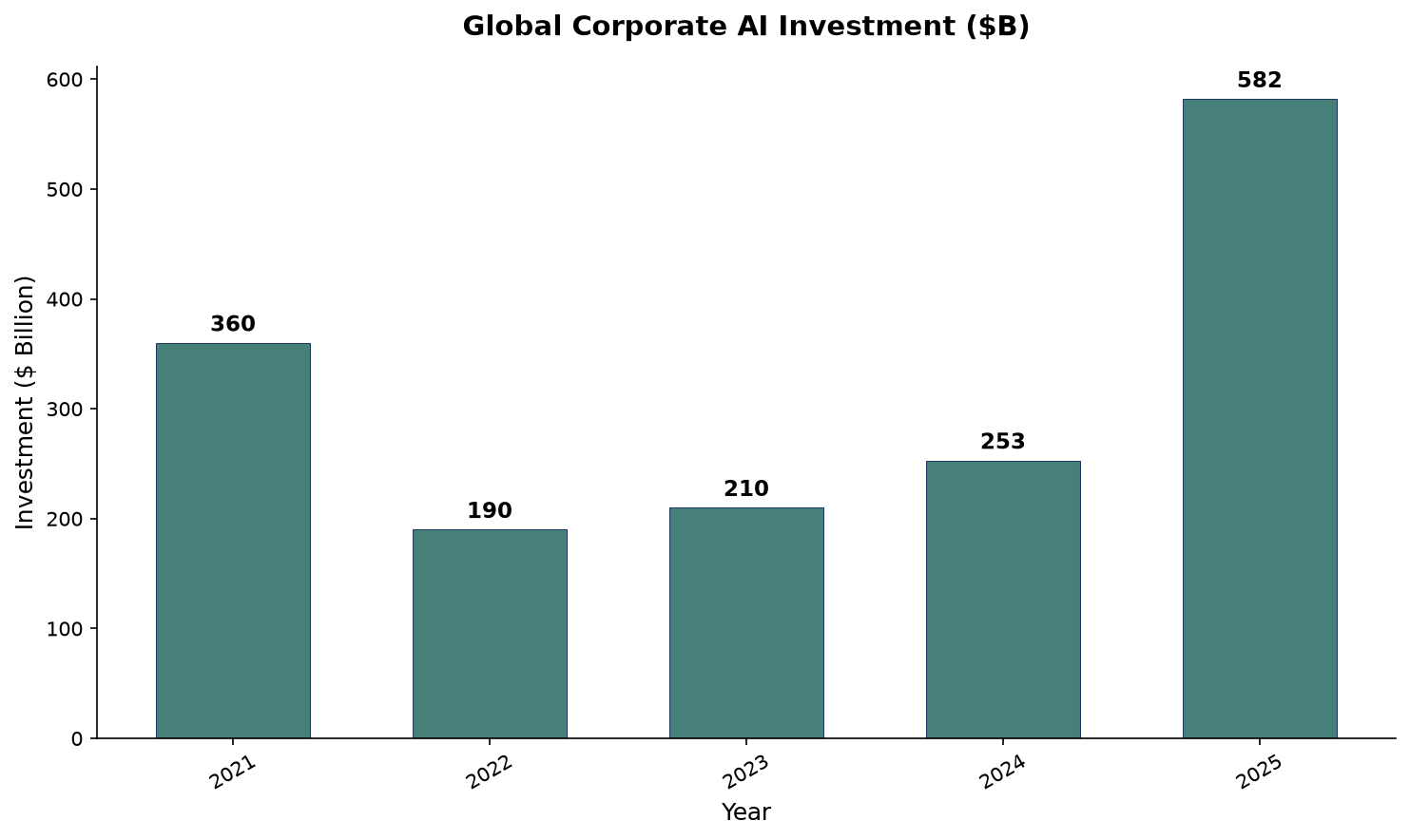
Global corporate AI investment hit $581.7 billion in 2025, a 130% increase from $253 billion in 2024. This surpasses the previous record of $360 billion set in 2021, and unlike that year — which was driven by mergers and acquisitions — 2025’s surge was led by private investment in AI companies. Private AI investment alone reached $344.7 billion, growing 127.5% year over year.
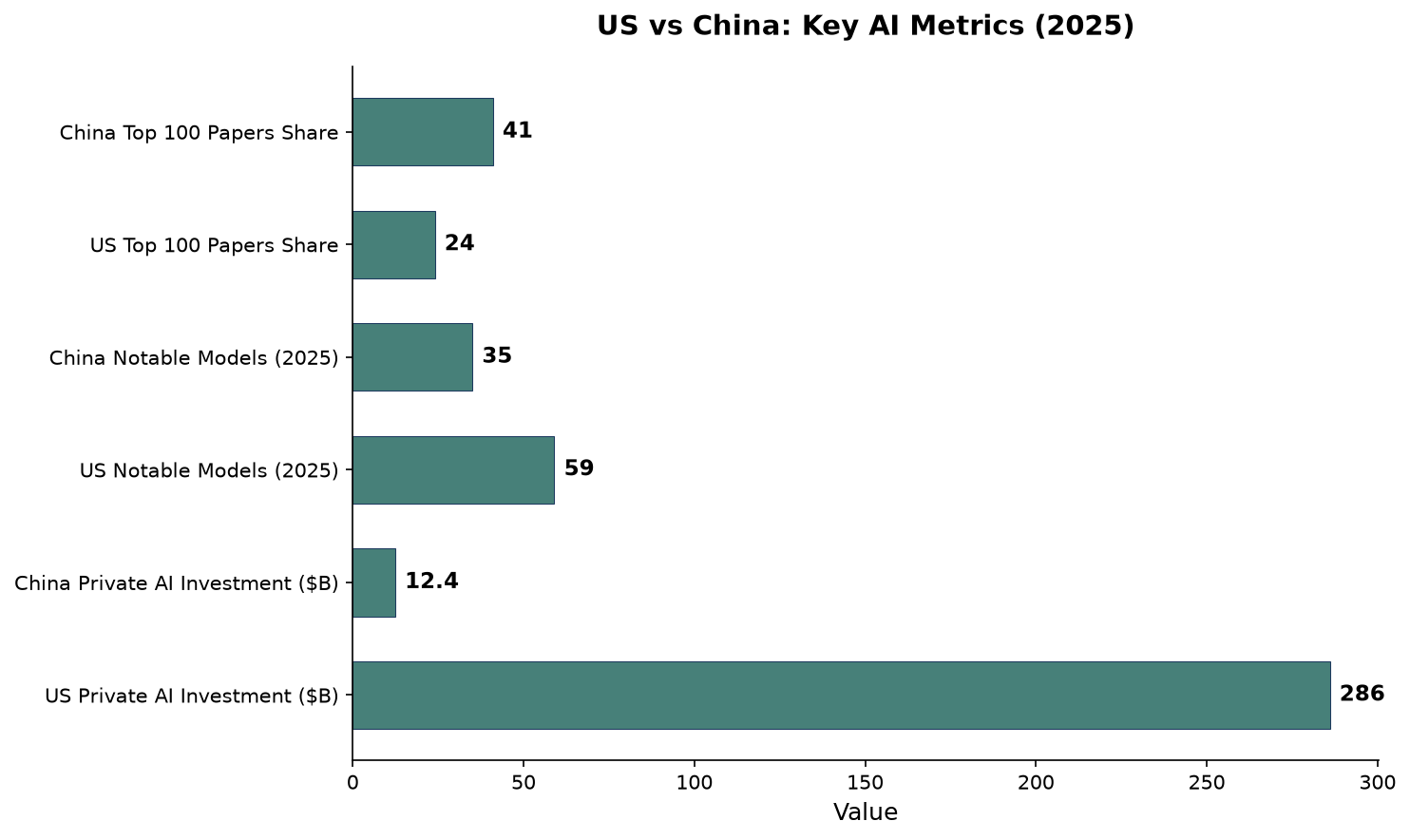
Generative AI led the surge, growing more than 200% and capturing nearly half of all private AI funding. Newly funded AI companies rose 71%, and billion-dollar funding rounds nearly doubled. The United States accounted for $285.9 billion in private AI investment — more than 23 times China’s $12.4 billion. But the report notes that this figure likely understates China’s total AI spending, since government guidance funds have deployed an estimated $184 billion into AI firms between 2000 and 2023.
Trend 2: Has AI Coding Reached Human Parity?
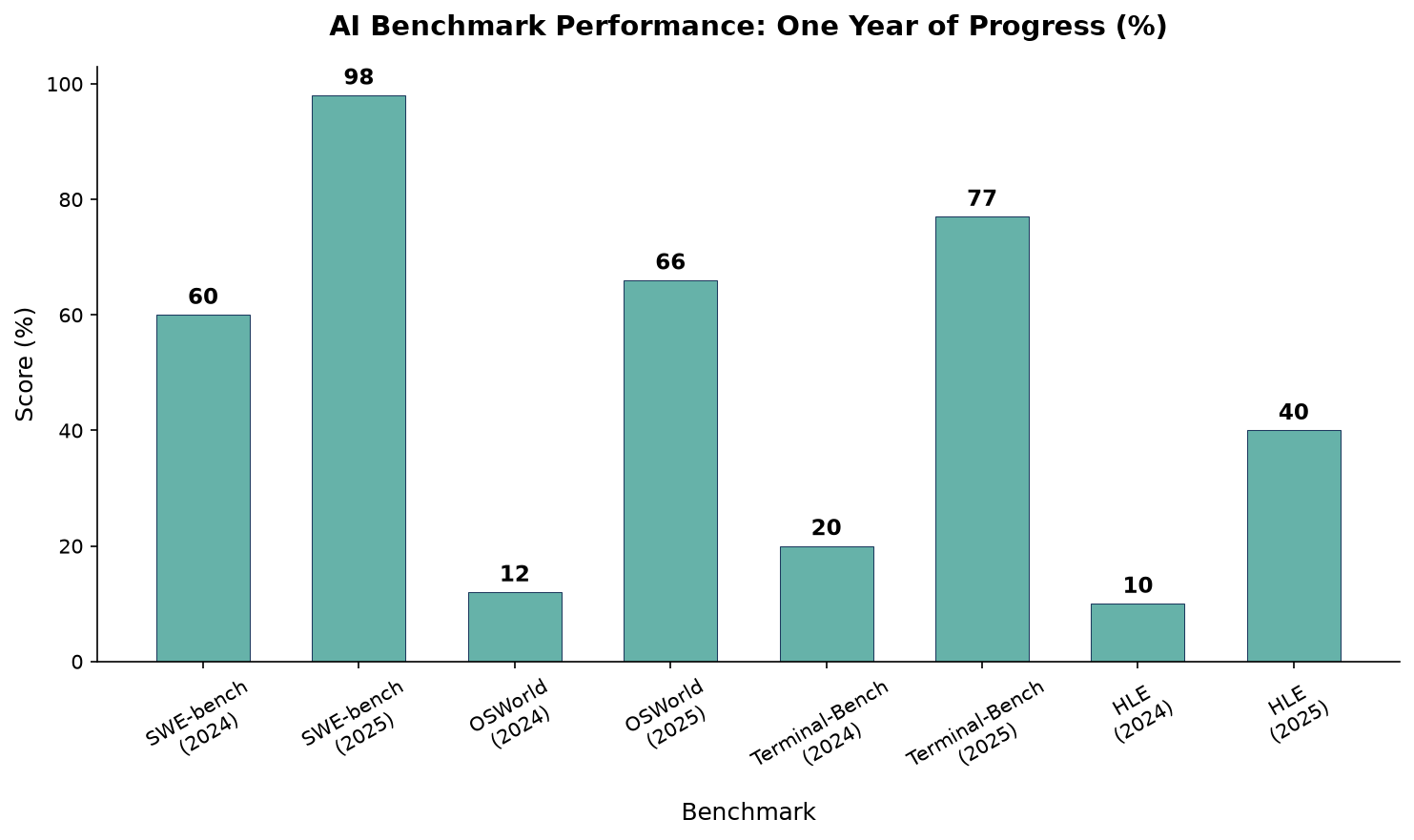
On SWE-bench Verified, which tests AI’s ability to solve real-world software engineering problems, performance rose from 60% to near 100% of the human baseline in a single year. On Humanity’s Last Exam — a benchmark designed to be hard for AI and favorable to human experts — frontier models gained 30 percentage points in a single year. Google’s Gemini Deep Think won a gold medal at the 2025 International Mathematical Olympiad, scoring 35 points within the 4.5-hour time limit, up from the 28-point silver achieved in 2024.
But the frontier is jagged. The same models that near-perfect coding benchmarks read analog clocks correctly only 50.6% of the time on ClockBench, compared to 90.1% for humans. On OSWorld, which tests AI agents on real computer tasks across operating systems, accuracy jumped from roughly 12% to 66.3% in a single year — within 6 percentage points of human performance. On Terminal-Bench, real-world task success rose from 20% to 77.3%. MMLU, once the gold standard benchmark, is now saturated above 92%, forcing the research community to develop harder evaluations.
Yet robots succeed at only 12% of real household tasks like folding clothes, despite scoring 89.4% in simulation. The lab-to-reality gap remains enormous.
Trend 3: How Close Are Frontier AI Models to Each Other?
On the Chatbot Arena leaderboard, the top six models — Anthropic, xAI, Google, OpenAI, Alibaba, and DeepSeek — are now clustered within 25 Elo points of each other. Anthropic holds the top position at 1,503, followed by xAI at 1,495, Google at 1,494, OpenAI at 1,481, Alibaba at 1,449, and DeepSeek at 1,424. The competitive landscape has flattened dramatically: a year ago, the gap between first and sixth place was more than twice as wide.
This convergence shifts competitive pressure away from raw capability and toward cost, reliability, and domain-specific performance. The commoditization of baseline intelligence has major implications for which companies capture value in the AI economy.
Trend 4: How Much Has the US-China AI Gap Narrowed?
As of March 2026, the top US model leads China’s best by just 2.7% on the Arena Elo leaderboard, down from a gap of 17.5 to 31.6 percentage points in May 2023. Since early 2025, US and Chinese models have traded the top position multiple times. In February 2025, DeepSeek-R1 briefly matched the leading US model, and the gap has fluctuated in the single digits ever since.
China now leads in AI research publication volume, citations, and patent grants. Its share of the top 100 most-cited AI papers grew from 33 in 2021 to 41 in 2024. The US, however, retains an edge in higher-impact patents and produced 59 notable AI models in 2025 compared to China’s 35. South Korea leads the world in AI patents per capita, while the US leads in total data center infrastructure with 5,427 facilities.
Trend 5: Why Has AI Talent Migration to the US Collapsed?
The flow of AI researchers and developers moving to the United States has dropped 89% since 2017, with an 80% decline in the last year alone. The US remains home to more AI talent than any other country, but it is attracting new talent at the lowest rate in over a decade. The report frames this as a structural vulnerability that investment alone cannot offset.
The open-source dynamic adds another layer. The performance gap between open and closed models has reopened: top closed models now lead top open models by 3.3%, up from just 0.5% a year earlier. This reverses the narrowing trend observed in 2024 when open models like Llama 3.1 405B briefly closed the gap. DeepSeek’s open-weight releases have been a notable exception, achieving frontier-competitive performance at a fraction of the training cost.
Trend 6: How Fast Is Generative AI Adoption Compared to Previous Technologies?
At the consumer level, generative AI reached 53% population adoption within three years of mass-market launch — faster than the personal computer or the internet achieved at the same point in their adoption curves. For context, it took the internet roughly seven years to reach comparable adoption levels. The estimated value of generative AI tools to US consumers reached $172 billion annually by early 2026, up from $112 billion a year earlier. The median value per user tripled over the same period, and most of these tools remain free or close to it.
Trend 7: How Widespread Is Organizational AI Adoption?
Organizational adoption reached 88% of surveyed organizations in 2025, up from 78% a year earlier. Generative AI is now used in at least one business function at 70% of organizations. Adoption varies widely across countries and correlates strongly with GDP per capita. Some countries outpace what income would predict, including Singapore at 61% and the United Arab Emirates at 64%. Despite its lead in AI investment and model development, the United States ranks 24th in population-level adoption at 28.3%. For a detailed breakdown of adoption by company size and industry, see our AI Adoption Report 2026.
AI agent deployment, meanwhile, remains in the single digits across nearly all business functions — a gap that represents both a current limitation and a future opportunity. The infrastructure for autonomous agents — tool use, browser navigation, code execution — is rapidly maturing, but enterprise deployment has not yet followed.
Trend 8: What Is the First Evidence of AI-Driven Job Displacement?
The Stanford AI Index 2026 provides the first concrete evidence of AI-driven job displacement in a specific demographic. Employment for software developers ages 22 to 25 has fallen nearly 20% from 2024 levels, even as overall tech employment has remained stable. This suggests AI is primarily compressing the entry-level hiring pipeline — reducing the number of junior positions available as a first job — rather than eliminating existing roles across the board. For a deeper analysis of how this trend reshapes hiring strategy, see our guide on whether you still need to hire experts in the AI era.
One-third of organizations surveyed expect AI to reduce their workforce in the coming year. Productivity gains from AI are largest in structured, measurable work: 14% to 15% in customer support, 26% in software development, and 50% in marketing output. Gains are smaller in tasks requiring deeper reasoning. Recent evidence raises concerns that heavy AI reliance may carry long-term learning penalties that slow skill development over time.
Trend 9: Why Are AI Models Becoming Less Transparent?
The most capable AI models are now the least transparent. The Foundation Model Transparency Index, which evaluates how openly labs disclose training data, methods, and limitations, dropped from an average score of 58 to just 40 out of 100 — a 31% decline in a single year. Training code, parameter counts, dataset sizes, and training duration are no longer disclosed for several of the most resource-intensive systems, including those from OpenAI, Anthropic, and Google.
This decline comes at a time when industry now produces over 90% of notable AI models. Academia’s share of frontier model development has eroded to single digits. The concentration of AI capability in a small number of private companies with declining transparency creates challenges for researchers, policymakers, and the public trying to understand what these systems can and cannot do.
Trend 10: How Many AI Incidents Were Documented in 2025?
Documented AI incidents rose to 362 in 2025, according to the AI Incident Database tracked in the report. This increase reflects both growing real-world deployment and improved reporting, but the direction is clear: as AI capability expands, so do the unintended consequences. The incidents span misinformation generation, biased decision-making, privacy violations, and safety failures.
Governance efforts are also accelerating. The number of AI-related regulations passed globally grew from 27 in 2016 to 157 in 2025. The European Union’s AI Act entered into force in 2025, and several US states passed their own AI legislation in the absence of federal action. But the report notes that regulatory capacity is struggling to keep up with the pace of technical change. Public sentiment has shifted modestly positive: 59% of respondents to an Ipsos survey said AI’s benefits outweigh its drawbacks, up from 55% in 2024.
Trend 11: How Large Is AI’s Environmental Footprint?
The environmental footprint of AI is growing faster than most organizations realize. Training a single frontier model — such as xAI’s Grok 4 — generated an estimated 72,816 tons of CO₂ equivalent emissions. For perspective, this is roughly equivalent to the annual emissions of 16,000 passenger vehicles. It represents a massive increase from GPT-4’s estimated 5,184 tons and Llama 3.1 405B’s 8,930 tons.
Total AI data center power capacity reached 29.6 GW in 2025, comparable to the peak electricity demand of New York state. The annual inference water use for GPT-4o alone may exceed the drinking water needs of 1.2 million people in regions already facing water stress.
Emissions from inference vary dramatically across providers. Carbon emissions from models with the least efficient inference are over 10 times as high as those with the most efficient inference. DeepSeek’s V3 models consume around 23 watts when responding to a medium-length prompt, while Claude 4 Opus consumes about 5 watts — a more than 4x efficiency gap for comparable tasks.
Trend 12: How Fast Is AI Compute Capacity Growing?
AI compute capacity has grown 3.3× per year since 2022, reaching 17.1 million H100-equivalents of global capacity. The United States hosts more data centers than any other country, and one Taiwanese foundry fabricates the majority of chips inside them — a concentration of geopolitical risk that has no historical parallel in technology infrastructure.
Open-source AI continues to scale rapidly, with 5.6 million AI-related projects on GitHub and Hugging Face uploads tripling since 2023. The report’s central finding may be its most uncomfortable: AI capability is advancing faster than the benchmarks designed to measure it, faster than the governance frameworks designed to regulate it, and faster than the public’s ability to absorb its implications. The gap between what AI can do and how prepared the world is to manage it has never been wider.
For policymakers, business leaders, and individual professionals alike, the Stanford AI Index 2026 delivers a clear message: the pace of change is not slowing. Organizations that treat AI adoption as a strategic priority — investing in workforce skills, updating governance frameworks, and building the infrastructure for responsible deployment — will be the ones that thrive in the coming years.
The report’s data also underscores a paradox: as AI capability concentrates in fewer hands with declining transparency, the need for public investment in independent evaluation infrastructure has never been greater. Without transparent benchmarks, auditable safety testing, and open access to model capabilities, neither policymakers nor the public can make informed decisions about the systems being deployed at society-wide scale. The gap between AI capability and societal readiness to manage it has never been wider — and closing it requires deliberate investment from both public and private sectors.