
Featured image: Abstract visualization of neural network input and output — how AI systems perceive data. Photo by Rose Pilkington on Pexels (Free to use).
In June 2025, OpenAI, Google, and Anthropic controlled 72% of all AI inference tokens processed on major platforms. By June 2026, that number had fallen to 33%. In twelve months, nearly 40 percentage points of market share transferred from the industry’s most valuable proprietary providers to open-weight and Chinese models that cost a fraction of the price.
This is not a gradual erosion. It is a structural break. DeepSeek V4 delivers competitive performance at $0.14 per million tokens — roughly 1/20th of GPT-5’s comparable tier. GLM-5.2 beats GPT-5.5 on coding benchmarks at one-sixth the cost. The open-source share of inference tokens grew from approximately 1% to 15% in twelve months by one measure, and the combined non-Big-3 share reached 67% by another. The pricing era of premium AI is over. The infrastructure-as-commodity era has arrived.
What Does the Data Say About Open vs Closed AI Market Share?
The market share shift is the single most important structural change in the AI industry in 2026. Different measurement methodologies produce different absolute numbers, but they all point in the same direction: the proprietary incumbents are losing share at an accelerating rate.
Token consumption data through June 2026 shows the combined share of OpenAI, Google, and Anthropic at 33%, down from 72% in June 2025.
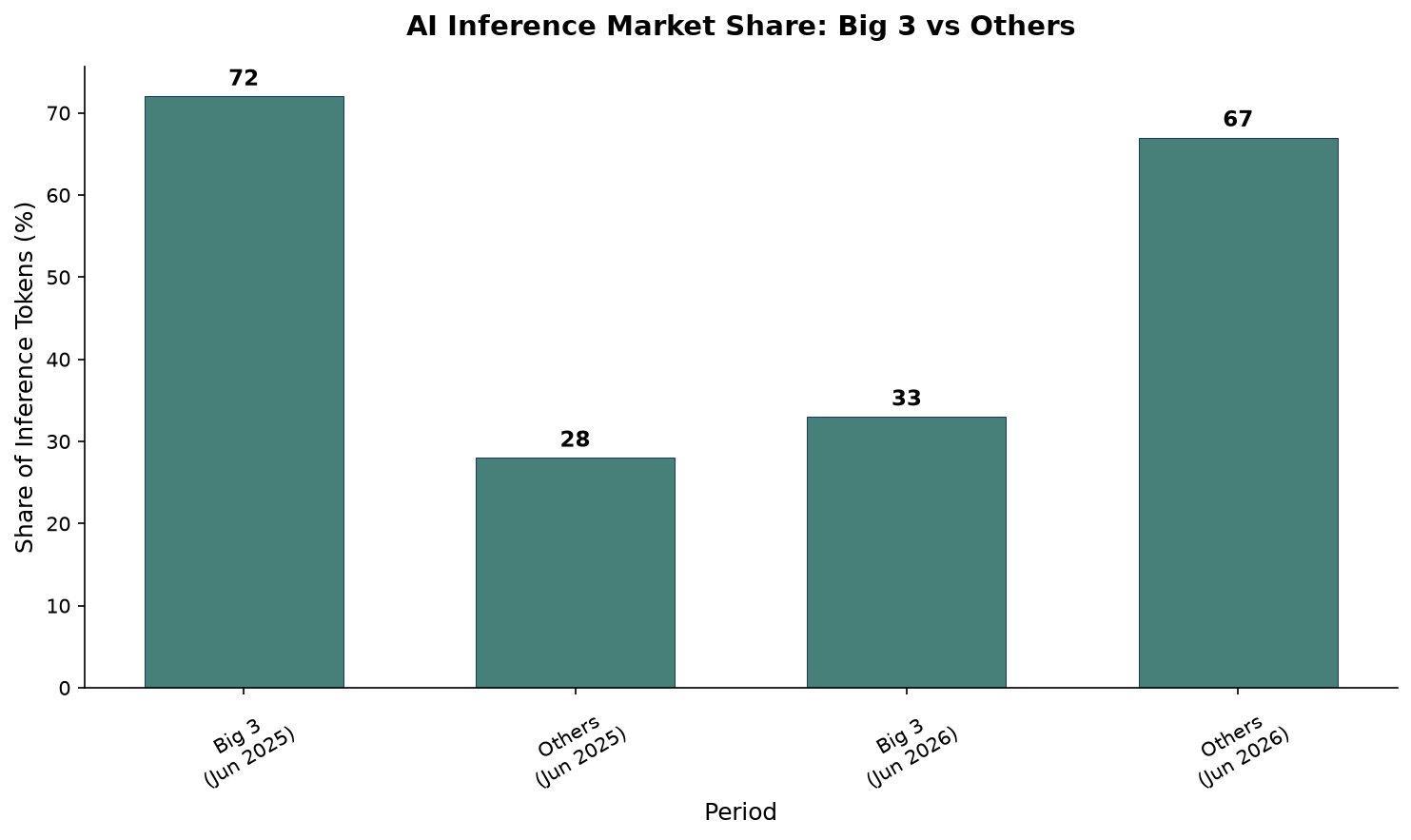 The challengers doing the taking are DeepSeek, GLM-5.2, Meta’s Llama family, Qwen, Kimi, and Mistral. Each arriving at a fraction of the cost of the incumbents — and increasingly, at comparable or superior performance on specific tasks.
OpenRouter, the leading AI inference platform, provides a detailed window into user preferences. Over a five-month study period, closed models accounted for close to 80% of AI token usage on the platform and nearly 96% of revenue. But OpenRouter attracts users who are already more willing to experiment with open models. The broader market tells a different story. Enterprises vote with their budgets, and the trend is unmistakable.
Presenc AI’s enterprise survey data shows open-weight models captured approximately 15% of inference market share by January 2026, up from approximately 1% twelve months earlier. Growth was driven by DeepSeek V3 and V4, Qwen 3 and 3.5, Llama 4, Kimi K2.6, and GLM-5.1 releases that reached or approached frontier capability on multiple benchmarks. By June 2026, the trajectory suggests that number has climbed further.
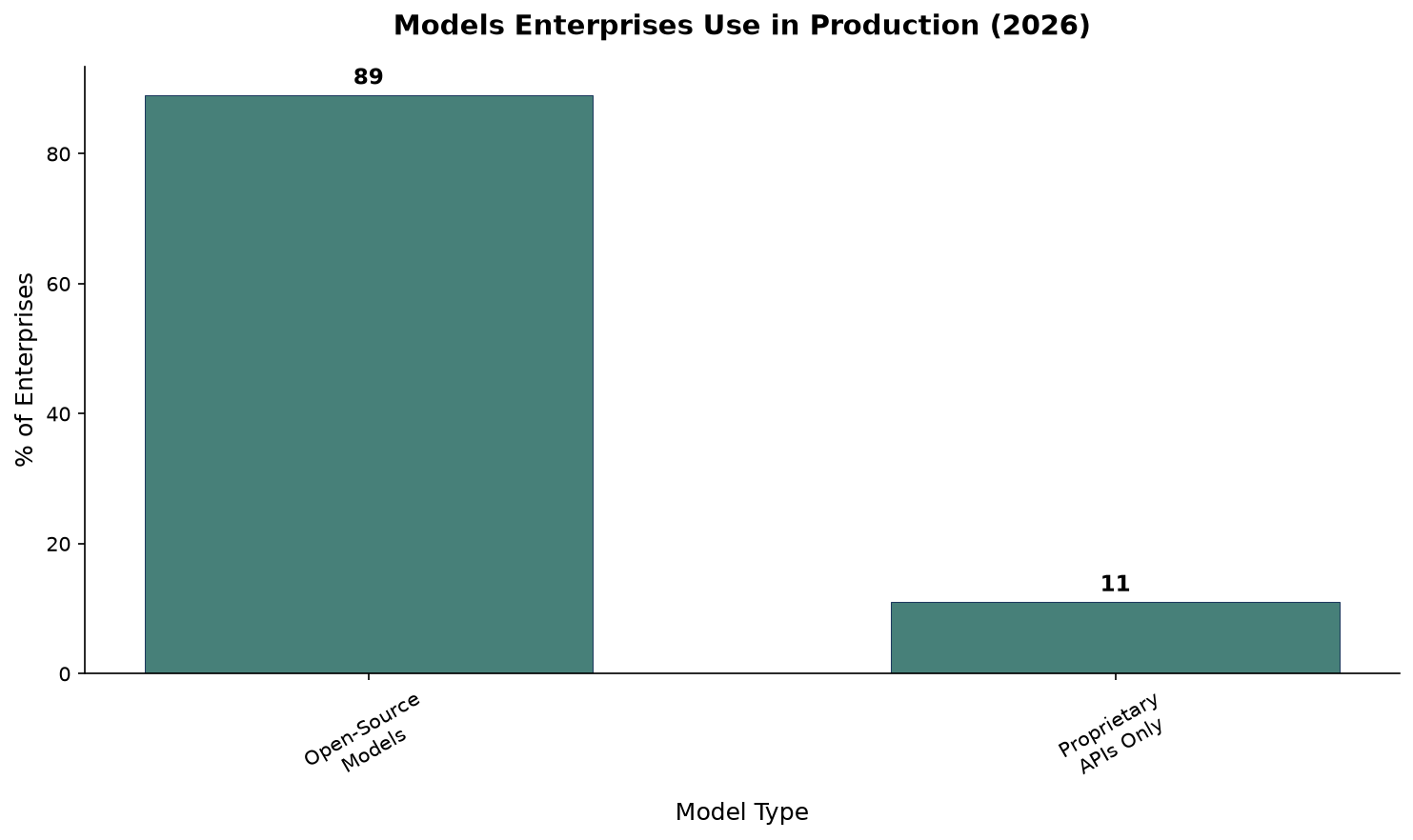
Eighty-nine percent of enterprises now use at least one open-source model in production, according to Presenc AI’s Q1 2026 survey. This is the most revealing statistic in the entire shift: even enterprises that continue to pay for proprietary APIs are running open models alongside them. The question is no longer whether to use open-source AI — it is which models to use for which workloads.
Why Are Open-Source Models Gaining Share So Quickly?
Three forces are driving the shift simultaneously: price, performance convergence, and the removal of switching costs.
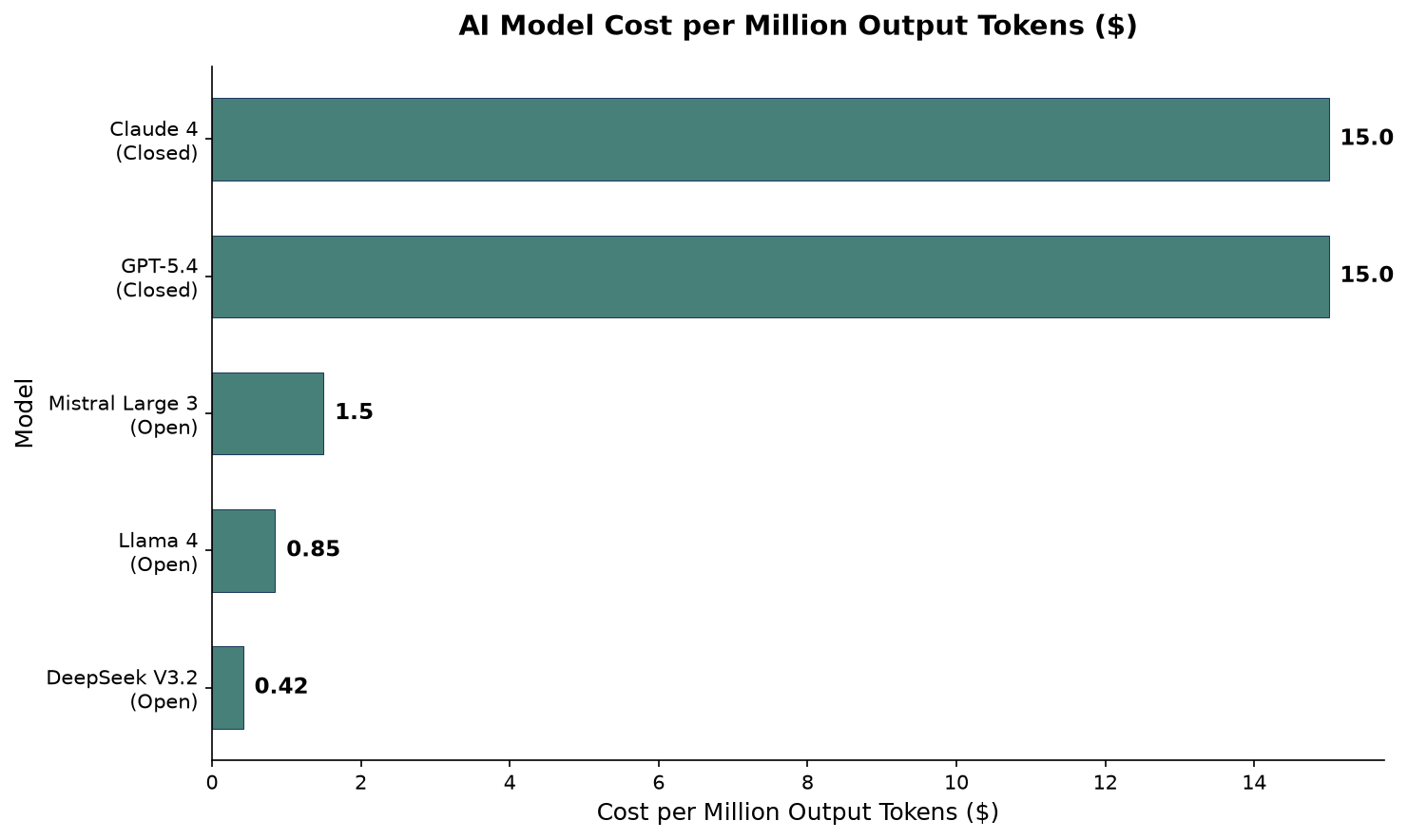
Price is the most visible factor. DeepSeek V3.2 costs $0.28 per million input tokens and $0.42 per million output tokens through hosted providers. Compare that to GPT-5.4 at $2.50 input and $15.00 output — a 36x difference on output tokens. The MIT Sloan study by Frank Nagle and Daniel Yue found that closed models cost 87% more to run on average — $1.86 per million tokens versus $0.23 for open models. The researchers calculated that optimal substitution from closed to open models could save the global AI economy approximately $25 billion annually.
For a mid-size enterprise running 10 billion tokens per month, the difference between GPT-5.4 and DeepSeek V3.2 is roughly $150,000 per month in API costs versus $4,620 per month. At that scale, the CFO does not need a benchmark evaluation to make a decision. The math decides.
Performance convergence is the second driver. On standard benchmarks — MMLU, GSM8K, HumanEval — the gap between the leading open-weight model and the leading closed model was approximately 1 to 5 percentage points in 2026 and effectively closed for production purposes. On reasoning benchmarks like ARC-AGI-2 and SWE-Bench Verified, closed models retain a 15 to 30 percentage point lead. But for the vast majority of production workloads — customer support, code generation, data extraction, classification, summarization — open-source models deliver comparable quality.
The removal of switching costs is the third and most structural force. Enterprise AI infrastructure has matured to the point where model routing is becoming a standard architectural pattern. Companies abstract their model layer so they can route between providers based on cost and capability rather than being locked into a single vendor. This is the opposite of the proprietary software era, where switching costs increased over time. In AI, switching costs are collapsing — and that benefits the open-source side of the market disproportionately.
How Do the Economics of Open vs Closed AI Compare?
The cost differential between open and closed models is not marginal — it is structural. It reflects fundamentally different business models rather than temporary pricing differences.
Closed models carry a premium that covers the cost of developing frontier AI capabilities. OpenAI’s annualized revenue reached approximately $13 billion in 2026, and Anthropic’s reached approximately $5 billion. But these numbers exist alongside extraordinary capital requirements: cognitive infrastructure depreciation consumes roughly two-thirds of AI company revenue. The premium pricing model is not arbitrary — it reflects the real cost of funding frontier research and the massive compute infrastructure required to train and serve the best models.
Open-weight models benefit from a different economic structure. Meta, for example, releases Llama models at no direct cost because the models drive value to Meta’s ecosystem through other channels. DeepSeek and Qwen benefit from Chinese government support and a domestic market that operates under different competitive dynamics. Mistral operates as a hybrid, offering both open and paid tiers. The result is that open models can be priced at marginal cost — or below — because their creators monetize through other means.
The MIT Sloan paper provides the clearest quantification. The researchers used OpenRouter data to model what would happen if all users optimally substituted to the best available open models. The result: average costs would fall by more than 70% while benchmark performance would improve by more than 14%. Extrapolated to the broader AI inference market — estimated at $35 billion by Menlo Ventures — the potential savings reach approximately $25 billion per year.
Self-hosting further tilts the economics. Running open-source models on your own infrastructure eliminates API margin entirely. As inference-optimized hardware matures — Groq LPUs, custom ASICs, and specialized AI accelerators — the cost of self-hosting continues to decline. For enterprises running high-volume workloads, self-hosting open models is already cheaper than any API option, including the cheapest open-model APIs.
Is There Still a Performance Gap Between Open and Closed Models?
The answer depends on the workload, which is why the question itself is being reframed by enterprise buyers. Rather than asking which model is better in absolute terms, sophisticated organizations ask which model is optimal for each specific task.
On routine benchmarks, the gap has effectively closed. The leading open-weight model is within 5 percentage points of the leading closed model on MMLU, GSM8K, and HumanEval. For text classification, data extraction, summarization, and standard customer support — the workhorses of enterprise AI — the performance difference is negligible in practice.
On coding and reasoning, the picture is more nuanced. GLM-5.2 beats GPT-5.5 on coding tasks while costing one-sixth as much. DeepSeek V4 ranks alongside GPT-5-class models on coding benchmarks. But on complex reasoning benchmarks — FrontierMath, Humanity’s Last Exam, and ARC-AGI-2 — closed models retain a 15 to 30 percentage point advantage. These are the tasks that require step-by-step logical deduction, mathematical reasoning, or novel problem-solving that training data does not directly cover.
The practical implication is that the optimal enterprise architecture is not a single model but a tiered stack. Open-weight models for high-volume routine inference. Closed-model APIs for reasoning-heavy or sensitive workflows. This is exactly what 89% of enterprises are now doing — using both. The question is not open versus closed. The question is routing optimization: which workloads go to which models, and how to minimize total cost while maintaining quality.
Anthropic’s enterprise market share leadership illustrates this dynamic. Anthropic holds roughly 32% of the enterprise LLM API market in 2026, compared to OpenAI’s 25%. This reversal from 2023, when OpenAI controlled more than 50% versus Anthropic’s 12%, reflects enterprise buyers choosing a provider whose safety positioning and coding performance align with their requirements. But even Anthropic’s growth exists alongside an even faster-growing open-source segment. The API pie is growing, but its relative share of the total AI inference market is shrinking.
How Are the Big 3 Responding to the Open-Source Insurgency?
The incumbents are not standing still, but their responses reveal the structural difficulty of competing with open-source economics.
OpenAI launched three new pricing tiers in rapid succession — GPT-5.6 Sol at the premium end, Terra at roughly half the cost, and Luna as the cheapest option ever offered. The pricing compression confirms the threat is real. But each tier compresses margins further. Global AI revenues hit $25 billion in Q1 2026 (excluding China), but depreciation consumes two-thirds of that figure. OpenAI’s positioned is structurally constrained: compete on price and undermine the R&D budget that funds frontier research, or defend premium pricing and lose share.
Google has responded by integrating Gemini more deeply into its existing enterprise ecosystem — Workspace, Google Cloud, and Android. The strategy is not to win on price or capability alone but to bundle AI into products that enterprises already use. This is a defensible position, but it limits AI revenue to the extent that Google’s cloud and productivity businesses grow rather than to the AI market’s expansion.
Anthropic continues to focus on safety and coding performance, winning enterprise developers in regulated industries where its positioning carries weight. But its ~$5 billion annualized revenue against OpenAI’s ~$13 billion illustrates the challenge of competing at scale when your rival has 800 million weekly consumer users via ChatGPT.
xAI, with Grok, has captured ~4% of the market by leveraging X’s user base — a reminder that distribution still matters in an era of commodity models.
The common thread across all proprietary providers is pricing compression. Every time Meta or Mistral releases a competitive open model, proprietary providers face pressure to cut prices, and they do. MIT Sloan research suggests the price gap between open and closed will continue to narrow, with flagship proprietary models dropping below $1.00 per million tokens for input and $10.00 for output in the near term, while open-source pushes below $0.10 and $0.30 respectively.
What Should Enterprises Do in This New AI Marketplace?
The optimal enterprise strategy has shifted from “pick the best model” to “build a routing architecture.” The winners in the new AI marketplace will not be the companies that standardize on a single provider. They will be the companies that can dynamically route workloads to the cheapest acceptable model for each task.
The first step is abstracting the model layer. Enterprises should adopt infrastructure that allows switching between providers without architectural changes. This is the opposite of the hyperscaler lock-in strategy — and it is becoming standard practice. Vercel’s CEO publicly stated that his company routes between models based on cost and performance rather than being tied to any single provider.
The second step is segmenting workloads by complexity. High-volume routine tasks — classification, extraction, summarization, standard customer support — should route to open-weight models by default. Reasoning-heavy, sensitive, or high-stakes tasks — contract analysis, medical diagnosis support, complex code generation — should use premium APIs where the quality premium justifies the cost premium.
The third step is monitoring the cost-performance frontier in real time. The AI model market is moving faster than any technology market in history. A model that is not cost-optimal today may become optimal next month, and vice versa. Enterprises that treat model selection as a quarterly decision rather than a continuous optimization process will leave margin on the table.
The fourth step is preparing self-hosting capability for high-volume workloads. As inference hardware costs decline and open models improve, the economics of self-hosting will become increasingly attractive. Enterprises that invest in internal AI infrastructure now will capture the full cost advantage of open models rather than sharing it with API providers.
Where Is the AI Model Market Headed in 2027?
The trajectory is clear even if the exact endpoints are not. The premium pricing era in AI inference is ending. The market is moving toward a commodity infrastructure model where model capability is widely available at marginal cost, and value accrues to the application layer rather than the model layer.
MIT Sloan’s projection that flagship proprietary models will drop below $1.00/$10.00 per million tokens seems conservative. At current rates of compression, those numbers could be reached within 12 months. Open-source models pushing below $0.10/$0.30 for flagship-quality is if anything a conservative estimate given the rate of improvement from DeepSeek, Qwen, and the Llama ecosystem.
The bigger question is what happens to the frontier. If proprietary providers cannot sustain premium pricing, their ability to fund the next generation of frontier research may be constrained. This is the tension at the heart of OpenAI’s current strategy: the company must simultaneously invest in GPT-6-level capabilities while defending a business model that the open-source ecosystem is systematically undermining. The cognitive infrastructure depreciation that already consumes two-thirds of AI company revenue will only become more punitive as pricing compresses.
The most likely outcome is a bifurcated market: commodity inference served by open-weight models at near-zero margins, and frontier capability concentrated among a small number of well-capitalized providers whose value proposition rests on reasoning depth, safety guarantees, and enterprise integration rather than raw benchmark scores. The era of paying 36x more for the same quality is ending. The question is what replaces it.