Featured image: US dollar bills stacked on a laptop keyboard with a financial graph in the background. Photo by Karola G on Pexels (Free to use).
The fastest way to measure the US-China AI price gap is to put the same budget on each side and count what comes back. On official API pricing as of August 2026, a $100 budget buys roughly 3.3 million output tokens on OpenAI’s flagship GPT-5.6 Sol, 83 million on its budget tier Luna, and about 357 million on DeepSeek V4 Flash. That is a 107x difference between the two countries’ cheapest frontier-tier options — and the gap is not an accident of marketing. It is the product of two fundamentally different business models.
This analysis is built exclusively on published list prices: OpenAI’s GPT-5.6 pricing tiers (Sol, Terra, Luna) and DeepSeek’s V4 Flash and V4 Pro rates, both current as of August 2026. It translates those prices into practical terms — output tokens per dollar, real-world workload costs, and the situations where the gap narrows or flips.
Why Does the US-China Price Gap Matter in 2026?
The gap matters because it has stopped being a technical footnote and become a procurement decision. For years, developers accepted premium prices as the cost of frontier quality. That assumption broke in 2025-2026, when Chinese open-weight models reached frontier-class performance at a fraction of the cost and enterprises began routing workloads across providers instead of standardizing on one. The Stanford HAI 2026 AI Index shows US and Chinese models trading the lead on major benchmarks since early 2025, with the top US model holding just a 2.7% advantage over the best Chinese alternative as of March 2026. When two countries’ models are this close in quality, price stops being a tiebreaker and becomes the main event.
The economic stakes are measurable. Global AI inference spending is growing at double digits annually, and API token prices are the single largest variable line item in AI-enabled products. A team that routes its traffic intelligently can cut its model bill by 10x or more without sacrificing output quality — savings that in 2026 are large enough to decide whether an AI product is profitable at all. This is the practical reality behind the abstract “AI price war” headlines, and it is why this article focuses on what a fixed budget actually returns on each platform rather than on benchmark scores alone.
How Much Do GPT-5.6 and DeepSeek-V4 Actually Cost per Token?
As of August 2026, OpenAI charges between $0.20 and $5.00 per million input tokens and between $1.20 and $30.00 per million output tokens across the GPT-5.6 family, while DeepSeek charges $0.14 to $0.435 input and $0.28 to $0.87 output for its V4 models. The cheapest DeepSeek tier is 107x cheaper than the most expensive OpenAI tier on output tokens.
| Model | Input ($/MTok) | Output ($/MTok) | Context | Released |
|---|---|---|---|---|
| GPT-5.6 Sol | $5.00 | $30.00 | 1.05M | Jul 30, 2026 |
| GPT-5.6 Terra | $2.00 | $12.00 | 1.05M | Jul 30, 2026 |
| GPT-5.6 Luna | $0.20 | $1.20 | 1.05M | Jul 30, 2026 |
| DeepSeek V4 Pro | $0.435 | $0.87 | 1M | 2026 |
| DeepSeek V4 Flash | $0.14 | $0.28 | 1M | Jul 31, 2026 |
Source: OpenAI platform pricing and DeepSeek API docs, retrieved August 2026.
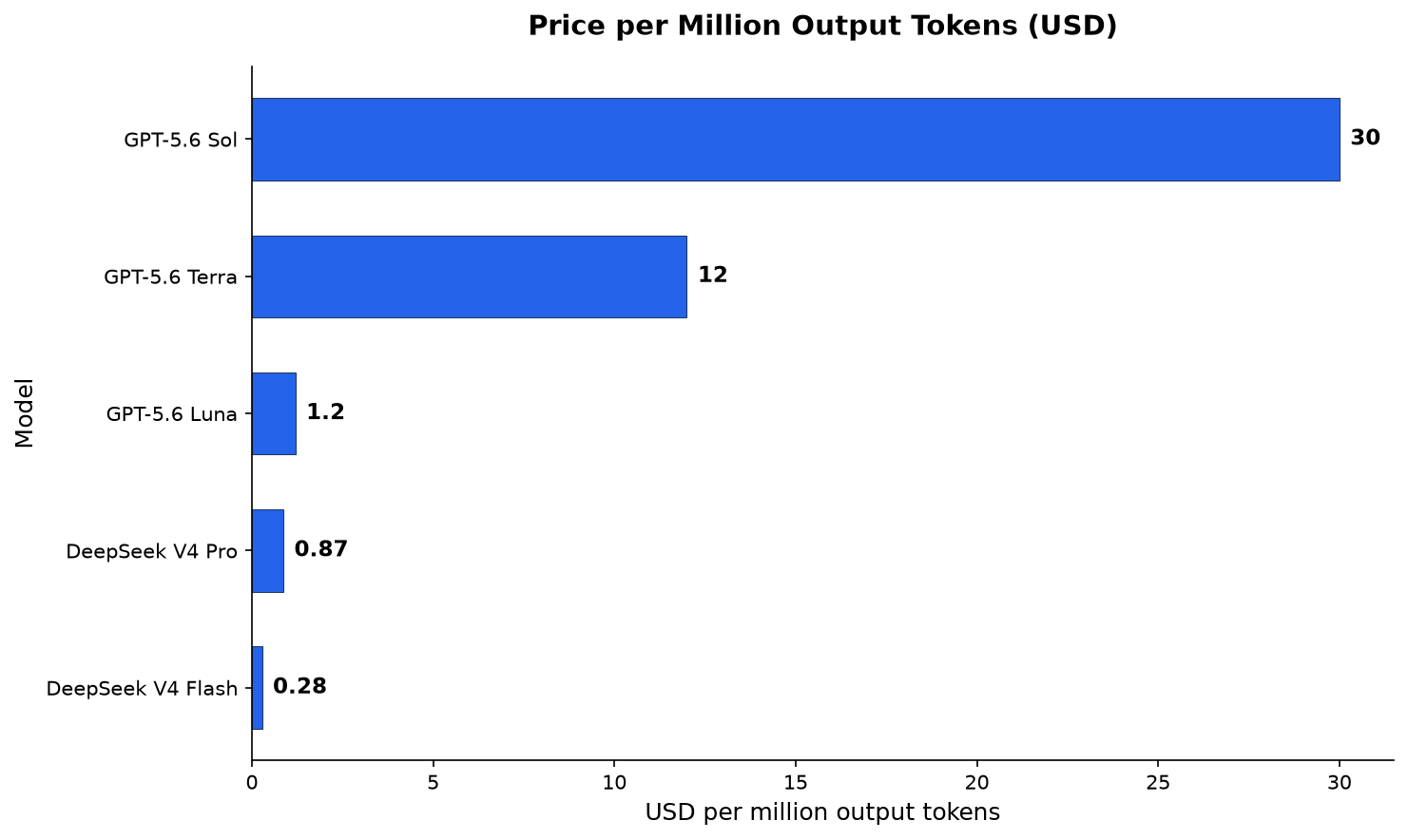
Every number in this article reflects list prices from those two pages, which are the authoritative sources. Actual invoices vary with caching, batch discounts, and throughput, but the list prices establish the structural relationship: the gap between the two ecosystems is measured in tens of times, not percentages. This is the widest price spread between frontier competitors since the AI API market took shape, and it is the economic engine behind the market-share shift documented in our open-source vs proprietary AI analysis.
What Can You Actually Do With $100 on Each Platform?
With a $100 budget and the cheapest tier on each side, you can generate about 357 million output tokens on DeepSeek V4 Flash versus 83 million on GPT-5.6 Luna — a 4.3x difference. Against GPT-5.6 Sol, DeepSeek V4 Flash delivers 107x more output, and even DeepSeek’s higher-priced V4 Pro still delivers 34x more output than Sol.
The table below translates $100 into concrete volumes for every tier, assuming no caching discount and equal input/output split:
| Model | $100 → Input tokens | $100 → Output tokens | Output vs Sol |
|---|---|---|---|
| GPT-5.6 Sol | ~20M | ~3.3M | 1.0x |
| GPT-5.6 Terra | ~50M | ~8.3M | 2.5x |
| GPT-5.6 Luna | ~500M | ~83M | 25x |
| DeepSeek V4 Pro | ~230M | ~115M | 34x |
| DeepSeek V4 Flash | ~714M | ~357M | 107x |
Source: Computed from official list prices in OpenAI’s pricing table and DeepSeek’s pricing table.
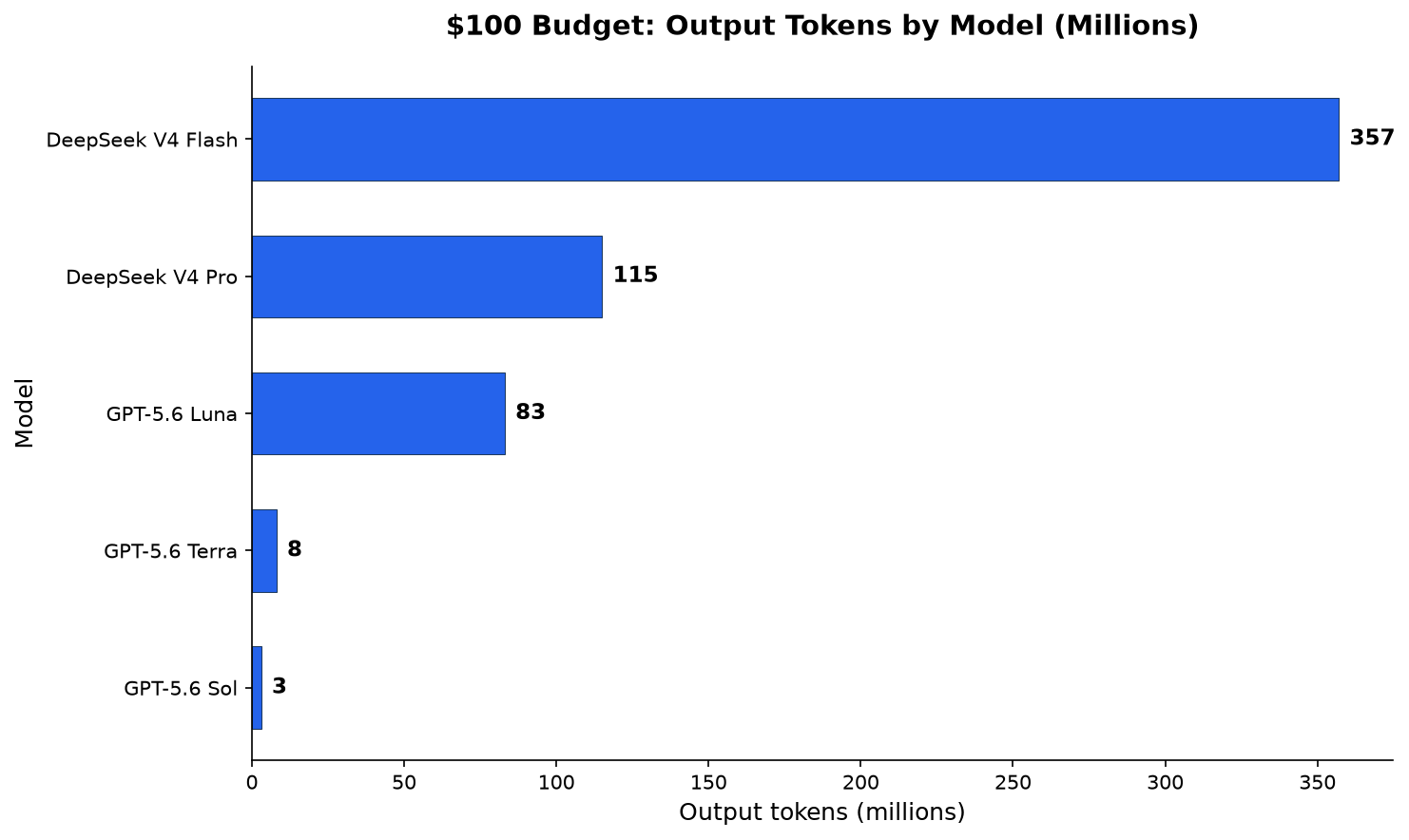
Source: Computed from official list prices in OpenAI’s pricing table and DeepSeek’s pricing table, August 2026.
These are output-token figures, which matter because output tokens are the scarce resource in AI applications: they are 6 to 10 times more expensive than input tokens on every tier. A team that burns through millions of output tokens a month — running agent loops, code generation, or document processing — feels the DeepSeek advantage on every invoice. A low-volume user sending a few thousand tokens a day will barely notice any difference at all.
Why Is DeepSeek So Much Cheaper Than OpenAI?
DeepSeek’s pricing reflects three structural advantages: training on cheaper domestic compute, an open-weights distribution strategy that shifts serving cost to the community, and aggressive pricing intended to capture usage and mindshare in a market where OpenAI must recover tens of billions in frontier R&D. OpenAI’s list prices carry the cost of building the next model generation; DeepSeek’s carry the cost of running an efficient serving layer.
| Cost driver | OpenAI GPT-5.6 | DeepSeek V4 |
|---|---|---|
| Business model | Closed, revenue-funded R&D | Open weights, usage-led |
| Compute access | NVIDIA leadership chips | Domestic + older hardware, more efficient serving |
| Pricing goal | Recover frontier R&D + infrastructure | Win market share and token volume |
| Cache pricing | Premium tier available | Aggressive ($0.0028/MTok hit) |
OpenAI’s model is self-reinforcing: premium prices fund the compute and research that produce frontier models, and frontier models justify premium prices. DeepSeek’s is the mirror image: near-cost pricing maximizes adoption, and adoption feeds back into model quality through usage data and community contribution. The Stanford AI Index 2026 shows US and Chinese models now trade the lead on benchmarks, so the price gap is not buying a quality gap — it is buying a distribution strategy. When quality converges, price becomes the deciding variable, which is exactly what the US-China AI race data predicts.
The serving economics amplify the difference. OpenAI runs its flagship tiers on the most expensive accelerated hardware available and sells that cost into every token. DeepSeek, operating under different hardware constraints, has optimized for throughput per dollar — and its cache-hit pricing reflects an aggressive bet that most production AI traffic is repetitive. For workloads with stable system prompts, the effective cost drops toward $0.003 per million input tokens, a price point that makes continuous agent loops economically viable at scale. OpenAI offers caching too, but its discount lands well above DeepSeek’s floor. The two companies are not just charging different prices; they are betting on different shapes of AI usage.
What Does $100 Buy in Real Workloads?
In practical terms, the gap decides whether a workload is viable. A team running 10 billion tokens per month — split evenly between input and output — through GPT-5.6 Sol would spend roughly $175,000; the same volume on DeepSeek V4 Flash costs about $2,100. On Luna, it costs roughly $7,000. For most teams, the question is not which model is better — it is which tier keeps the project inside the budget.
| Workload (10B tokens/mo, 50/50 split) | Monthly cost | Cost ratio vs Sol |
|---|---|---|
| GPT-5.6 Sol | ~$175,000 | 1.0x |
| GPT-5.6 Terra | ~$70,000 | 2.5x |
| GPT-5.6 Luna | ~$7,000 | 25x |
| DeepSeek V4 Pro | ~$6,500 | 27x |
| DeepSeek V4 Flash | ~$2,100 | 83x |
Source: Extrapolated from official list prices (August 2026). Assumes 5 billion input and 5 billion output tokens monthly, with no caching discounts.
These are ceiling numbers; caching discounts in OpenAI’s and DeepSeek’s systems can pull them down substantially. DeepSeek’s cache-hit price for V4 Flash is $0.0028 per million input tokens — effectively free for repeated prefixes — which makes it dramatically cheaper again for workloads that replay stable system prompts, like agents and customer support bots. But even with generous caching assumptions, the ordering does not change: DeepSeek sits an order of magnitude below OpenAI’s premium tiers and several times below its budget tier.
A concrete example makes the spread tangible. A SaaS product runs a retrieval-augmented support bot answering 500,000 queries a month, each sending 2,000 input tokens and receiving 300 output tokens — a modest, realistic workload. That is 1 billion input and 150 million output tokens per month. On GPT-5.6 Luna, the input bill is about $200 and the output bill about $180, roughly $380 a month. On DeepSeek V4 Flash, input costs about $140 and output about $42 — about $182 a month. On GPT-5.6 Sol, the same bot costs about $9,500 a month. The same answers, the same bot, with a 50x spread between the most and least expensive viable tiers. For a product team not yet profitable, that spread decides whether the margin is healthy or subsidized.
What Does the Price Difference Not Include?
The per-token price is the headline number, but it is not the whole cost. Context length, feature availability, and operational maturity change the effective value of every tier.
Context length is effectively a tie. GPT-5.6 models support 1.05M tokens of context and DeepSeek-V4 supports 1M. For long-document work — contracts, codebases, research papers — both can ingest an entire corpus in a single call, so the 50K-token difference rarely decides anything. The bigger factor is how each provider charges for that context: DeepSeek’s near-zero cache-hit input price makes repeated long-context processing dramatically cheaper, while OpenAI’s cache discounts apply mainly to its premium tiers.
Feature coverage is where the two ecosystems diverge more clearly. OpenAI’s Responses API combines structured outputs, web search, file search, computer use, and function calling behind one interface, and the GPT-5.6 family shares that tooling across Sol, Terra, and Luna. DeepSeek currently exposes the Responses API only on V4 Flash; V4 Pro relies on the more traditional chat completions interface. A team that depends on OpenAI’s agent tooling pays an integration cost to move to DeepSeek that no per-token price captures.
Operational maturity differs as well. OpenAI offers enterprise SLAs, compliance certifications, region selection, and a support ecosystem that DeepSeek is still building for international customers. For regulated industries or strict procurement requirements, those are not optional extras — they can decide the outcome regardless of price.
The fair comparison is therefore not “price per token” but “price per completed, compliant workload.” On that basis, DeepSeek’s lead narrows for tool-heavy, compliance-sensitive applications and stays wide for bulk inference.
Is DeepSeek Actually Good Enough at That Price?
Price only matters if the model delivers. On published benchmarks, DeepSeek V4 is positioned against GPT-5-class models on coding and general reasoning, while OpenAI retains the edge on the hardest reasoning tasks. For high-volume production workloads — summarization, extraction, classification, code generation, customer support — the difference is often invisible to end users.
| Capability | Where DeepSeek V4 stands | Where GPT-5.6 leads |
|---|---|---|
| Coding | Near frontier (SWE-bench class) | Slight edge on novel tasks |
| General reasoning | Frontier-class | Frontier-class |
| Math / frontier reasoning | Strong | Stronger on hardest sets |
| Throughput & price | 10-100x cost advantage | Better tooling ecosystem |
| Agent tool calling | Supported (Responses API on Flash) | Deepest tool integration |
The practical pattern in 2026 is not “pick one model.” It is routing: send routine, high-volume work to the cheapest model that passes the quality bar, and reserve the premium tier for the tasks where the quality difference actually shows. Enterprises doing this report the cost structure in our open-source market analysis — a tiered stack rather than a single vendor. A $100 budget goes 100x further on the commodity tier, and the commodity tier handles most of the work.
The benchmark picture deserves nuance. On SWE-bench Verified, the leading coding evaluation, DeepSeek’s V4 models sit in the same band as GPT-5.4-class outputs of a year earlier while costing a fraction of GPT-5.6’s premium tiers. For code generation that produces boilerplate, glue code, or data transforms, both models clear the quality threshold comfortably, and the extra premium buys a smaller and smaller marginal gain. The tasks where the premium genuinely pays are open-ended, high-stakes reasoning — architecture decisions, contract clauses, novel algorithm design, regulatory analysis. There, the quality delta justifies the premium. For the rest, which is the bulk of enterprise traffic, it usually does not.
When Does the Gap Narrow or Flip?
The gap is not universal. It narrows when you use premium features, and it can reverse entirely when you factor in support, compliance, and tooling. Enterprise contracts, batch discounts, and negotiated rates can all compress the effective price difference, and OpenAI’s Responses API, structured outputs, and enterprise SLAs have no direct DeepSeek equivalent on the Pro model yet. For buyers negotiating at scale, the list-price gap is a starting point, not a final number.
The gap also shrinks with caching. Heavy cache hits reduce both providers’ effective prices, and OpenAI’s premium-tier caching narrows the relative gap on repeat workloads even though it cannot close it. On the other side, DeepSeek’s cache-hit rate of $0.0028 is so low that high-replay workloads — RAG pipelines, customer support, agent loops — become trivially cheap, widening the gap for exactly the workloads enterprises run at scale.
Finally, there is an explicit timing risk on the DeepSeek side: DeepSeek’s own API documentation states that it plans to raise overall pricing significantly in the near future. Anyone building a long-term cost model on today’s V4 Flash rates is pricing in a moving target. The structural gap will likely persist — it reflects business models, not a promotional campaign — but the specific multiplier will change, and teams should treat current DeepSeek rates as a floor, not a permanent ceiling.
Which Should You Choose for Your Budget?
The decision framework is simple: if your workload is high-volume, price-sensitive, and tolerant of a frontier-tier model with a slight reasoning deficit, DeepSeek V4 Flash delivers an order of magnitude more work per dollar. If your workload is reasoning-critical, low-volume, or requires enterprise tooling and support, the GPT-5.6 family — particularly Luna — keeps costs near DeepSeek’s while preserving the OpenAI ecosystem.
| Your situation | Cheapest sensible choice |
|---|---|
| High-volume agents, RAG, support | DeepSeek V4 Flash (107x tokens/dollar) |
| High-volume, needs OpenAI tooling | GPT-5.6 Luna |
| Frontier reasoning, contract analysis | GPT-5.6 Sol or Terra |
| Balanced cost/quality, enterprise | GPT-5.6 Terra |
| Price-first, quality-flexible | DeepSeek V4 Pro |
For most business teams, the winning pattern is not a single choice but a split: route commodity work to the cheapest tier that clears the quality bar, and keep a premium tier for the workloads that need it. That is the architecture the data — and the 89% of enterprises now running open models alongside proprietary APIs — points to. The US-China price war did not create one winner. It created the cheapest era of AI inference yet, and the teams that win are the ones that use both sides of the divide.