Featured image: A computer monitor displaying a video editing program in a tech-savvy workspace with mood lighting. Photo by abdo alshreef on Pexels (Free to use).
In 2025, AI video generation was a curiosity. In 2026, it is a $847 million market — and it is growing faster than almost any software category in history.
The numbers tell a clear story: 63% of video marketers now use AI tools to create or edit content, up from 51% just a year ago. Production costs have collapsed by over 90%. And the competitive landscape has stratified into distinct tiers, each optimized for a specific job.
This article is a data-driven field guide to what actually works in AI video generation in mid-2026. We analyzed 12+ verified sources — including Fortune Business Insights, Grand View Research, Wyzowl, Wistia, Artificial Analysis, and hands-on reviews of every major platform — to answer the only question that matters: which tool should you actually use, and for what?
The Market Has Crossed Three Quarters of a Billion Dollars
The global AI video generator market is valued between $847 million and $946 million in 2026, depending on scope, and is projected to reach $3.35 billion by 2034 — roughly 4× growth in under a decade. The text-to-video subsegment, the fastest-growing slice, is expanding at a 38.6% CAGR.
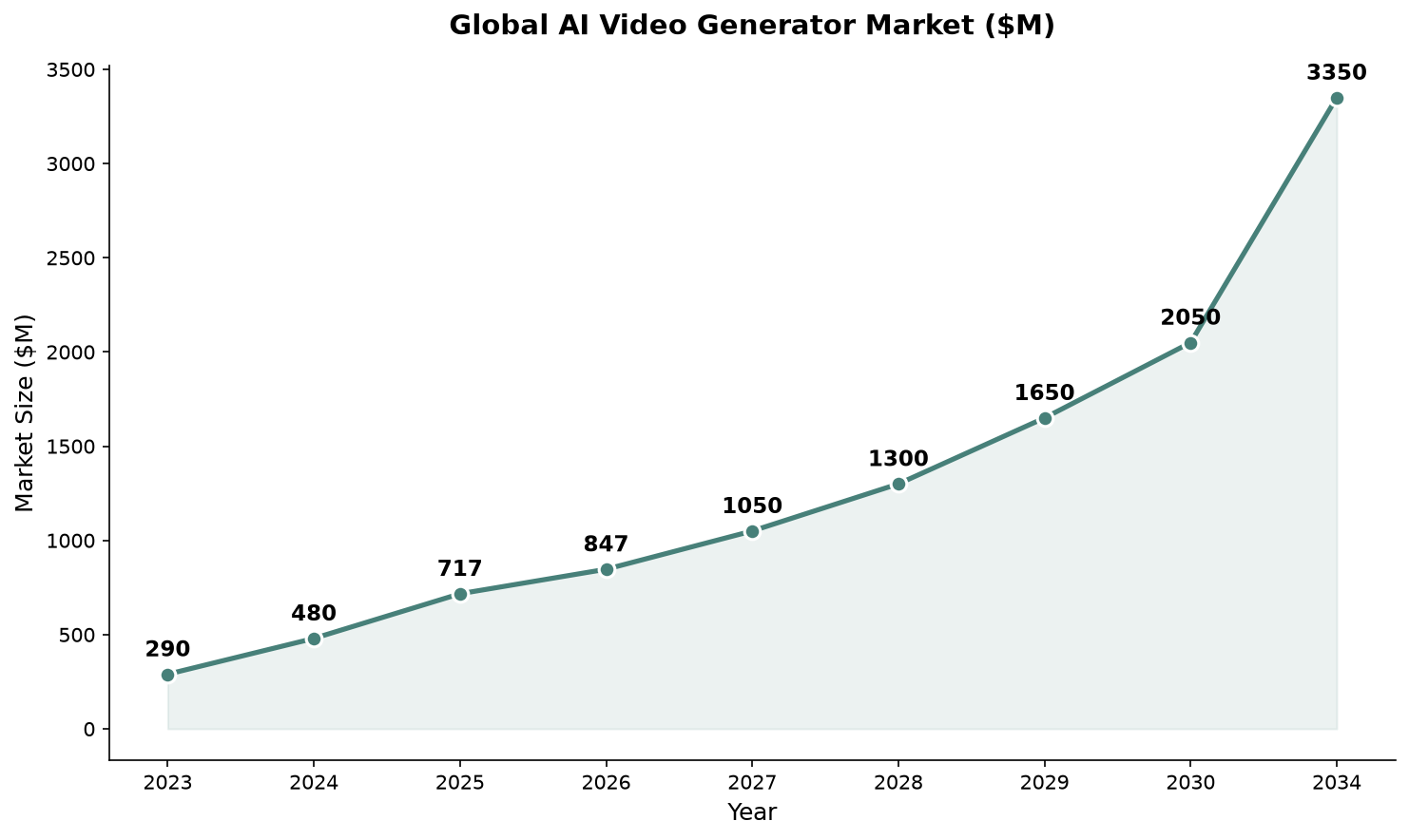
This is not hype — this is adoption velocity that matches or exceeds the early trajectory of cloud computing and SaaS. AI video is growing 3.6× faster than the traditional video editing software category (5.2% CAGR), and venture capital has taken notice. Dedicated AI video companies raised $3.08 billion in 2025 alone — a 94.6% increase from $1.58 billion in 2024.
The broader AI video market (including avatar platforms, video editing, and generation) is estimated at $3.8 billion in 2026, with projections reaching $28.2 billion by 2033 at a 33.2% CAGR. Monthly active users across dedicated AI video platforms have surpassed 124 million globally as of January 2026.
The Big Four (Plus Two)
The AI video market in 2026 has consolidated around four serious contenders, with two more worth watching. Each has a distinct strength and a clear weakness.
1. OpenAI Sora 2 — The Distribution King
Sora is the most famous AI video model, and its story in 2026 is the most dramatic. Launched publicly in December 2024, Sora reached 1 million downloads in five days — faster than ChatGPT itself. It hit 8 million monthly active users inside ChatGPT, roughly 3.5× Runway’s estimated 2.3 million.
Then the economics caught up. OpenAI was reportedly spending $15 million per day on compute costs for Sora while generating only $2.1 million in lifetime revenue. In March 2026, OpenAI shut down the consumer Sora app, leaving 500,000 creators stranded. The Sora 2 API is scheduled for full deprecation on September 24, 2026.
The June 2026 twist. Competitive pressure from ByteDance’s Seedance 2.0, Google’s Veo 3.1, and xAI’s Grok Imagine Video forced OpenAI to reverse course. Sora was relaunched inside ChatGPT in June 2026 with a more efficient model architecture, 60-second clips at 1080p, improved multi-shot consistency, and synchronized audio. It is now available across all ChatGPT tiers.
What Sora does best: photorealism and prompt adherence. In third-party blind comparisons by Artificial Analysis (Q1 2026, 1,200 prompts), Sora 2 won photorealism 71% of the time against Runway Gen-4 and 64% against Kling 2.0. For single-shot B-roll — cityscapes, product shots, landscapes — Sora is now indistinguishable from licensed stock at 1080p.
What Sora still cannot do: multi-shot continuity, precise camera control, or anything past 20 seconds (standard) to 60 seconds (Pro) in one clip. As one reviewer put it: “For single-shot B-roll, pay the $200. For storytelling, stay on Runway.”
Pricing: ChatGPT Plus ($20/month, 50 generations, 720p, 10s, watermark) or ChatGPT Pro ($200/month, unlimited, 1080p, 20-60s, no watermark). No standalone API available yet.
2. Google Veo 3.1 — The Audio + Photorealism Leader
Veo is the most technically impressive AI video generator available in mid-2026 — and it has a free tier. Google DeepMind’s Veo 3.1, updated in January 2026, adds true 4K generation at 3840×2160 (not upscaled), native 9:16 vertical output, and an improved ingredients-to-video pipeline that accepts up to four reference images.
The headline feature is native synchronized audio. Veo is the only major model that generates dialogue with frame-accurate lip-sync, ambient sound, and sound effects in the same pass as the video — at 48kHz stereo. A clip of rain on a tin roof includes the sound of rain on a tin roof. A character walking on gravel produces footsteps matching the visual cadence. In side-by-side tests, this alone is the single biggest reason to choose Veo over competitors.
Motion realism scores at 92% in third-party benchmarks. Flickering artifacts are reduced by 89% compared to Veo 2. Physics simulation — water, fabric, lighting — is consistently strong, producing footage that looks filmed rather than generated.
The trade-offs are real. Every native generation is 8 seconds (though Flow, Google’s filmmaking tool, chains clips to reach roughly 60 seconds). Every frame carries an unremovable SynthID watermark. And the pricing gap between free ($0, rate-limited) and the full experience ($249.99/month AI Ultra) is steep — there is no mid-tier subscription between $19.99/month and $249.99/month.
Pricing: Free (AI Studio, rate-limited, 720p), Google AI Pro ($19.99/month, 1080p, audio), Google AI Ultra ($249.99/month, 4K, priority), Vertex AI API (~$0.05–0.75/second depending on tier).
3. Runway Gen-4 / 4.5 — The Creative Control Standard
Runway is the professional’s choice. Valued at $5.3 billion after its $315 million Series E in February 2026, Runway is not a single model — it is a production platform hosting Gen-4.5, Google’s Veo 3, ByteDance’s Seedance 2.0, and custom editing tools like the Aleph video editor and Act-Two performance capture.
Runway wins on creative control. Motion Brush 3.0 lets you direct movement within a clip. Act-One delivers consistent characters across multiple shots. The Aleph editor modifies generated footage without regenerating — changing lighting or adding a prop without starting over. Multi-shot continuity is best in class: Gen-4 maintains a character’s face, wardrobe, and proportions across 4-5 cuts before drift becomes visible.
On the public AI video arena, Runway Gen-4.5 peaked at ELO 1,247 (December 2025), though it has since been overtaken by newer models like Kling 3.0 and Seedance 2.0, settling around the #9–15 range as of April 2026. The key insight: Runway’s competitive advantage is now the platform, not any single model.
The limitation: Gen-4.5 maxes out at 720p native resolution (with 4K upscaling), clip length is 10-20 seconds, and there is no native audio generation. You also need to stitch clips together in an external editor for anything beyond a single shot.
Pricing: Free (125 credits), Standard ($12/month annual, 625 credits), Pro ($28/month annual, 2,250 credits), Unlimited ($76/month annual, unlimited Gen-3, generous Gen-4 credits). API at $0.01/credit (~$0.05–0.15/second).
4. Kling 3.0 — The Value + Length Champion
Kling AI, built by Chinese short-video giant Kuaishou, is the most significant disruptor in AI video in 2026. With native 4K output (actually rendered at 3840×2160, not upscaled), multi-shot storyboarding (up to six shots in a single pipeline), and native audio with lip-sync, Kling 3.0 has become the value benchmark.
The free tier — 66 credits per day, daily reset, no watermark — is the most generous in the market. The Pro plan at $29.99/month delivers 3,000 credits, enough for serious production volume. And the max clip length of 60 seconds (via multi-shot storyboard, extending to roughly 3 minutes via chaining) is the longest of any major platform.
Kling has 22 million+ users and has generated 168 million+ videos. Its annualized revenue run rate reached $240 million in December 2025, just 19 months after launch. On the video quality arena, Kling 3.0 sits at ELO ~1,243 — within a whisker of Runway Gen-4.5’s peak.
The trade-off: 4K generation is slow (3-5 minutes per clip), character consistency across long sequences requires careful prompting, and credits expire monthly with no rollover.
Pricing: Free (66 credits/day, 720p), Standard ($5.99/month, 660 credits, 1080p), Pro ($29.99/month, 3,000 credits), Premier ($54.99/month, 8,000 credits). API at ~$0.07–0.14/second.
5. Pika 2.5 — The Viral Social Machine
Pika occupies a unique niche: it is the only platform built explicitly for viral social content. Its 16 Pikaffects — Squish, Melt, Explode, Cake-ify, Inflate — have no equivalent in any competing tool. Generation takes 20-40 seconds, and 1080p output is native.
Pika’s Standard plan at $8/month (annual) with 700 credits is the cheapest entry point to commercial AI video among Western platforms. But there is a catch: the Standard plan does not include commercial rights or watermark removal. You need Pro ($28/month) for that. Once you factor this in, the price advantage narrows.
Pricing: Free (80 credits, 480p, watermark), Standard ($8/month annual, 700 credits, 1080p, personal use only), Pro ($28/month, 2,300 credits, commercial), Fancy ($58/month, 6,000 credits). API via Fal.ai at ~$0.04–0.09/second.
6. Seedance 2.0 (ByteDance) — The Multimodal Dark Horse
Seedance 2.0, from ByteDance’s SEED lab, is the most multimodal model in the market. It accepts text, images, audio, and video as input — simultaneously. You can provide up to 9 images, 3 video clips, and 3 audio clips in a single prompt. Output is up to 15 seconds with dual-channel stereo audio.
The model is currently available primarily in China through ByteDance’s Jimeng and Doubao channels. Global availability is expanding but limited. Its benchmark performance is competitive with the top tier, and its unified multimodal architecture is technically ahead of every Western competitor.
What Each Platform Actually Costs
Cost per second is the headline metric, but the real number that matters is cost per finished video. Every published per-second rate needs to be multiplied by a revision factor (typically 1.4–1.8 generations per usable clip) and stacked with operator time.
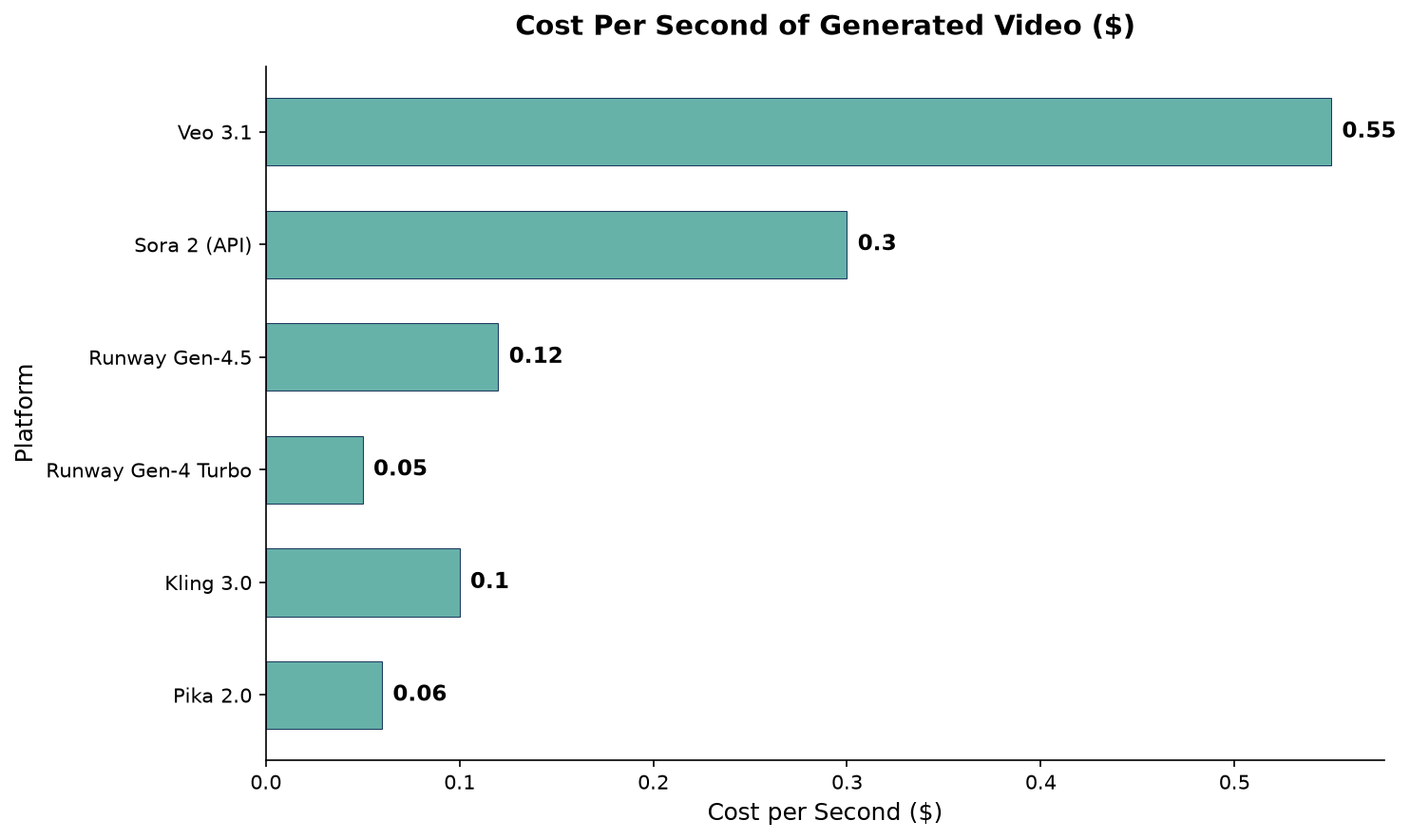
The difference between the cheapest and most expensive text-to-video platforms is roughly 4-7× for output most viewers would call “similar 1080p.” The premium tiers (Veo, Sora) earn the premium on physics, audio, narrative coherence, and character lock — not on raw resolution.
The fully-loaded cost picture:
| Format | Compute (post-revision) | Tools | Operator Time | Total per Video |
|---|---|---|---|---|
| Slideshow + AI narration | $0.20–0.80 | $6–22/mo voice | 8–15 min | $2–6 |
| AI-narrator + stock B-roll | $0.50–2.00 | $30–80/mo | 15–25 min | $5–15 |
| Avatar + B-roll (talking head) | $1.50–4.00 | $29–80/mo | 25–40 min | $8–25 |
| Generative-video heavy (Runway/Kling) | $4–25 | $70–150/mo | 60–180 min | $20–50 |
For a solo creator producing 5+ short-form videos per month, AI workflow runs $110–240/month all-in versus $750–6,750/month for a part-time editor at the same volume.
The Cost Revolution: AI vs Traditional Production
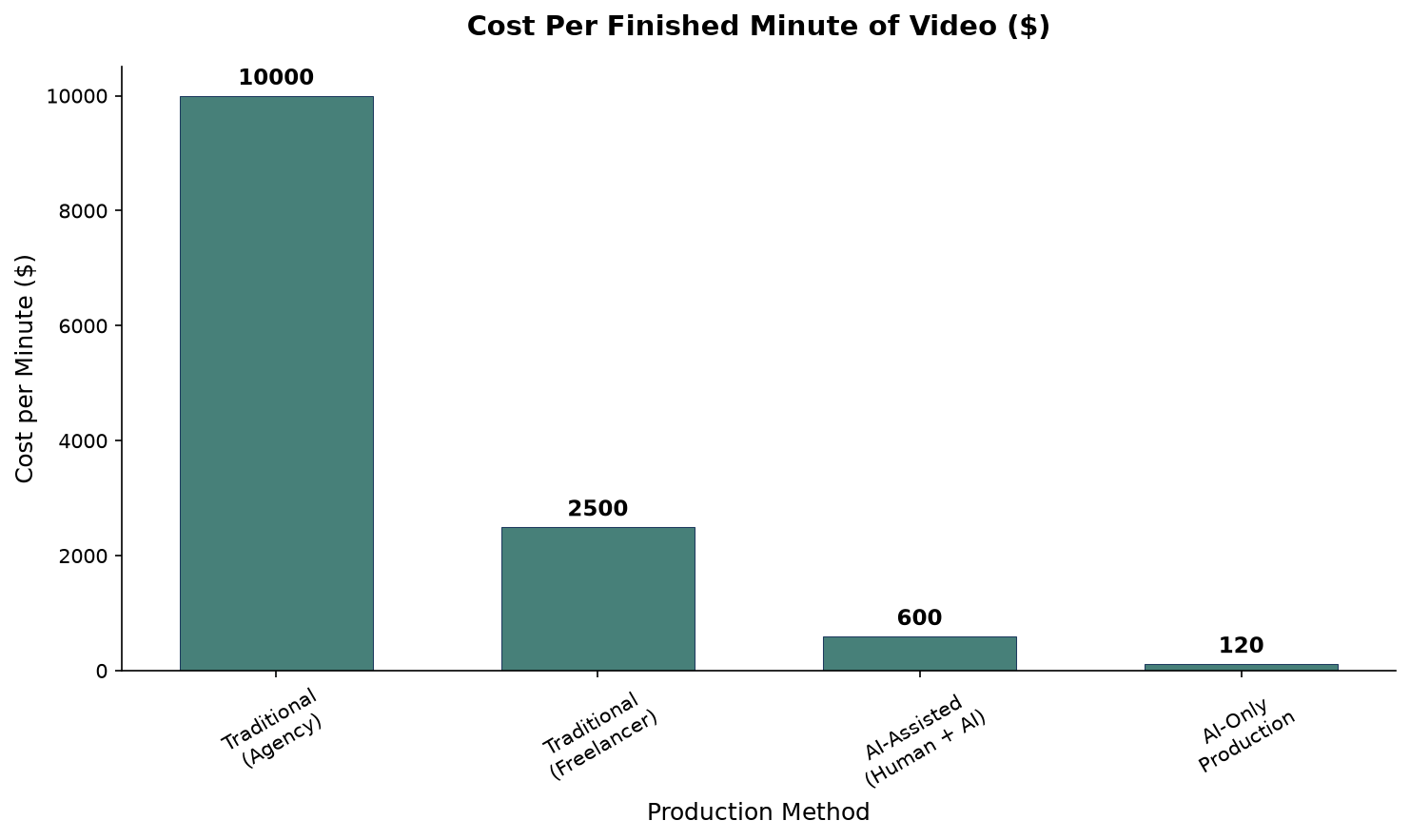
The most dramatic transformation in AI video is the unit economics. Traditional video production costs $4,000–18,000 for a 60-second commercial-quality product video. AI production costs $170–700 for equivalent output — a 90–96% reduction.
The breakdown:
| Metric | Traditional | AI-Generated | Reduction |
|---|---|---|---|
| Cost per finished minute | $1,000–10,000 | $50–500 | 90–99% |
| Timeline (60s video) | 2–6 weeks | 1–3 days | 85–95% |
| Revision cost per round | $500–1,500 | Near-zero (regenerate) | ~99% |
| Cost for 100 videos | $500,000+ | $5,000–15,000 | 97–99% |
The marginal cost curve is the truly transformative part. In traditional production, the 100th video costs roughly the same as the 1st. With AI, cost drops dramatically with volume — from ~$400 for the first video to ~$50 per video at scale.
Adoption: From Experiment to Infrastructure
AI video has crossed the chasm from experimentation to operational infrastructure. The data is unambiguous.
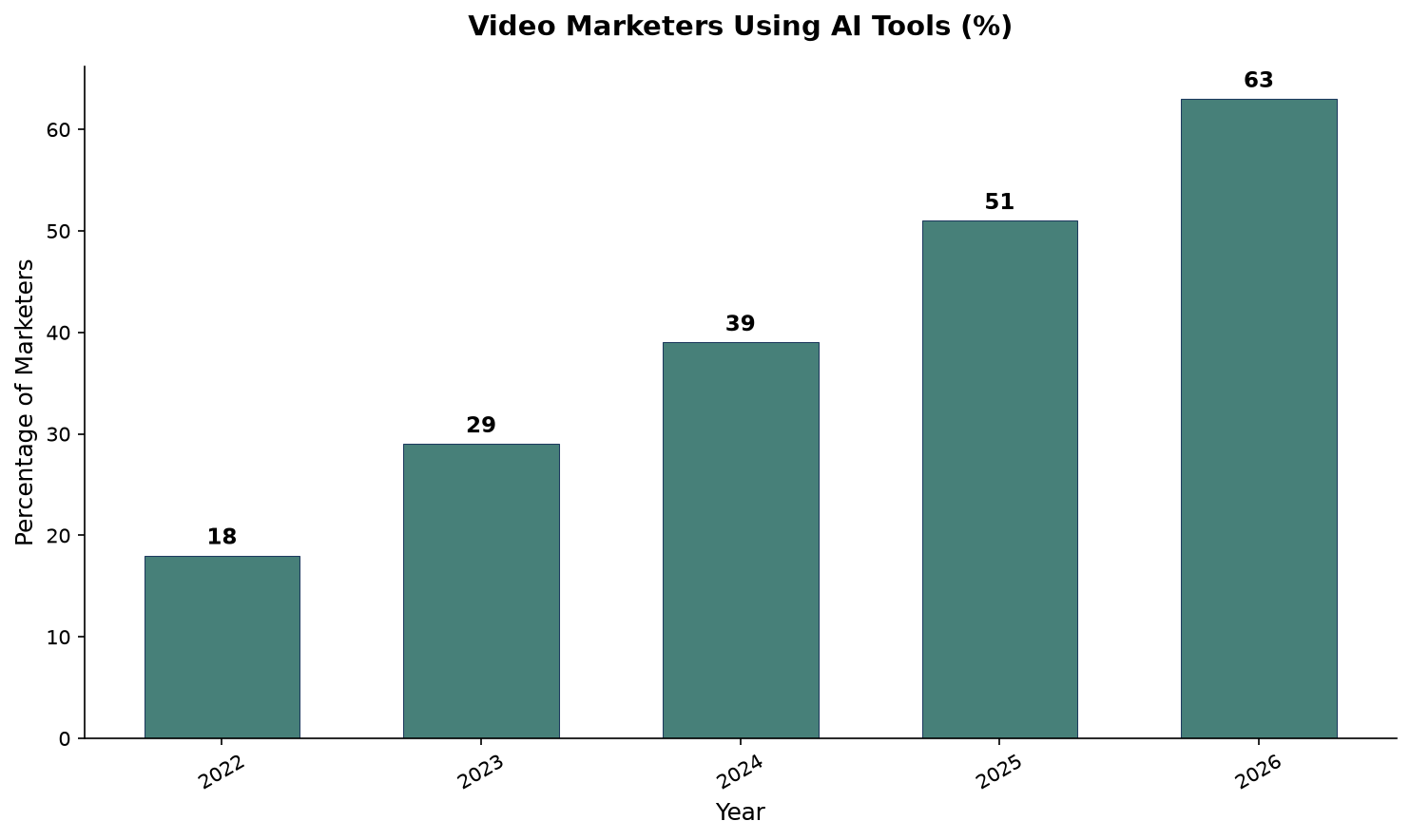
Key adoption metrics in 2026:
- 63% of video marketers use AI tools (Wyzowl), up from 51% in 2025 — a 12-point jump in one year
- 77% of organizations use AI video in some capacity (HeyGen State of Enterprise Video 2026)
- 78% of marketing teams incorporate AI-generated video into at least one campaign per quarter
- 91% of businesses use video as a marketing tool (joint all-time high)
- 86% of ad buyers are using or planning to use generative AI for video ad creative (IAB)
- 41% of professional production teams have formally adopted AI (Wistia), up from 18% in 2023
- Average enterprise now uses 3.2 different AI video tools simultaneously
- 60-65% of organizations are operating in the “operationalization layer” — moving from pilots to integrated production
The productivity impact is staggering. Agencies using AI video produce 11× more content per month with the same team size. Marketing teams save an average of 34 hours per week previously spent on video production. And 57% of creative agencies report a ≥38% reduction in production timelines.
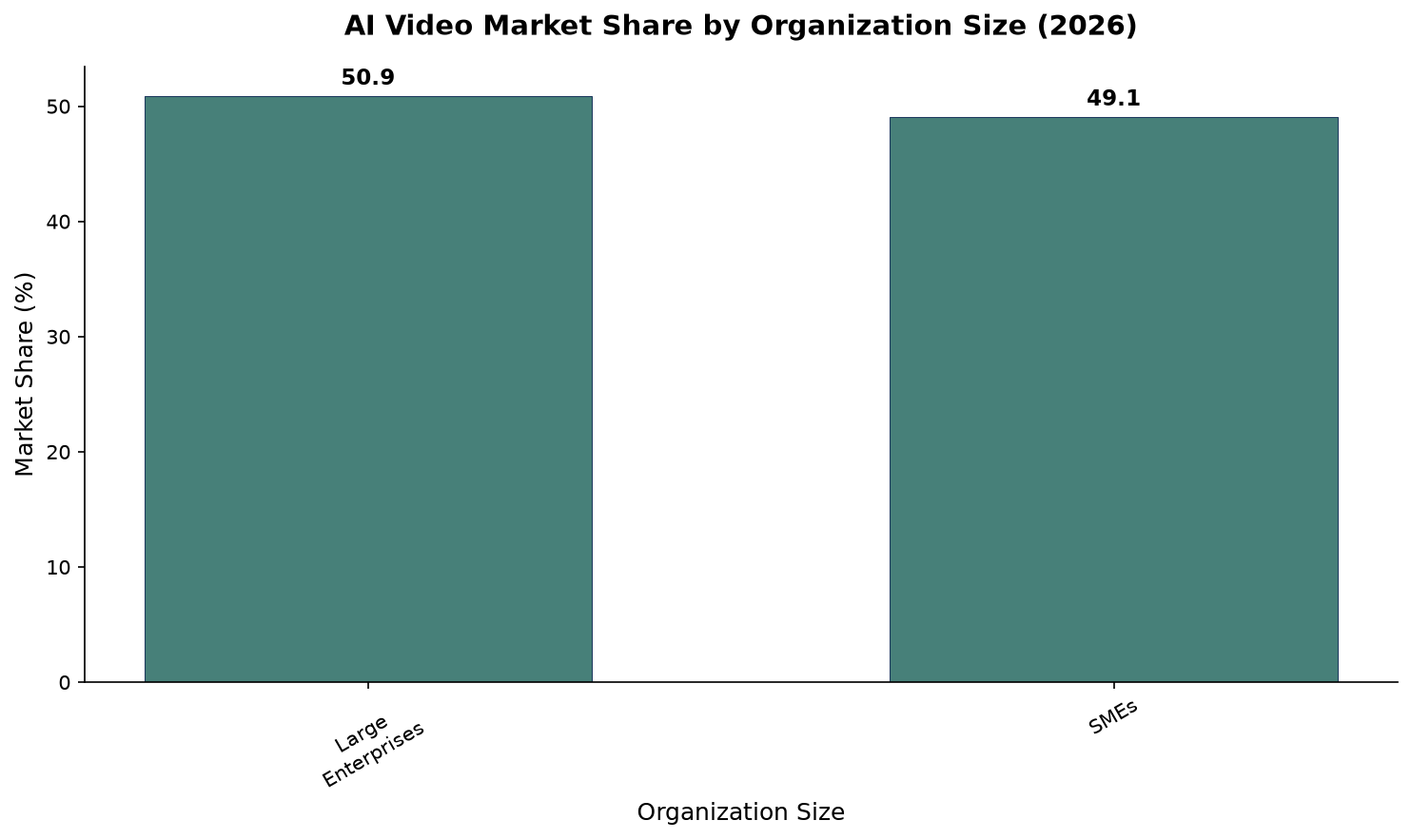
Enterprise adoption has followed a clear pattern. Large enterprises currently hold 50.86% of the AI video market, but SMEs are growing faster at a 21.1% CAGR — indicating the technology has crossed the accessibility threshold.
Where AI Video Still Breaks
For all the progress, AI video generation has well-defined failure modes. Understanding these is essential for anyone planning production workflows.
Duration limits. Every major platform still operates in clip-length constraints: 8 seconds (Veo), 10-20 seconds (Runway), 15-20 seconds (Sora), 5-10 seconds (Pika). Kling leads at 60 seconds via storyboard, but longer clips show quality degradation past 30-60 seconds. For anything narrative, you are stitching clips — and maintaining continuity across joins is still hit-or-miss.
Multi-shot continuity. Put two characters in a scene together, generating a conversation at a dinner table, and almost every model breaks. Characters merge, spatial relationships collapse, and audio tracks struggle to assign distinct voices. Single-subject and simple two-person scenes work. Anything more complex requires careful prompt engineering and multiple attempts.
Hands and micro-expressions. Hands at the 4-second mark remain a telltale failure point. Fingers merge, counts drift, and subtle facial expressions still carry the “uncanny valley” quality that signals AI generation to viewers.
Text rendering. On-screen text — signs, labels, screens — renders legibly only on Veo 3.1’s improved text pipeline. Every other model produces gibberish or blurred text more often than not.
Cost at production scale. While per-clip costs are low, the real cost compounds with iteration. One finished clip often requires 5-20 generations. For a 30-second finished video, that can mean 20-80 generations during drafting. At $0.08-0.17 per second of generated video, a single 30-second piece can burn $15-40 before you have something shippable.
The human bottleneck. Wyzowl reports that the #1 barrier to AI video adoption is no longer cost — it is in-house skills (43% of marketers). Teams have the budget; they lack the prompting expertise and workflow integration knowledge.
Platform Positioning by Use Case
The competitive field has stratified by use case rather than quality alone — the typical pattern in maturing AI markets.
| Use Case | Recommended Platform | Why |
|---|---|---|
| Photoreal B-roll, stock replacement | Sora 2 Pro | Best single-shot photorealism (71% blind-test wins) |
| Cinematic brand film, multi-shot narrative | Runway Gen-4.5 | Best creative control, multi-shot continuity, editing suite |
| Video with synchronized dialogue/audio | Veo 3.1 | Only model with native frame-accurate audio |
| High-volume social content, viral effects | Pika 2.5 | 16 unique Pikaffects, fastest generation, lowest entry price |
| Long-form product demos, value production | Kling 3.0 | Longest clips (60s), native 4K, best free tier, $29.99 Pro |
| Enterprise talking-head, training videos | Synthesia / HeyGen | Purpose-built for avatars, enterprise governance |
| Multimodal reference-driven creation | Seedance 2.0 | Best combined input (9 images + 3 video + 3 audio) |
The Verdict: Which Tool Should You Actually Use in 2026?
The era of a single best AI video generator is over. The right answer in 2026 is almost always a multi-tool stack.
If you need one tool for professional brand work: Runway Gen-4.5. The platform advantage — Aleph editing, Act-Two, multi-model access — outweighs the resolution and clip-length limitations.
If you need one tool for social content at scale: Pika 2.5 on the Pro plan. The Pikaffects are genuinely unique, and the generation speed enables rapid iteration.
If your budget is under $10/month: Kling 3.0 Standard. The 66 daily free credits with no watermark at 1080p is unbeatable value.
If you need the best single clip money can buy: Veo 3.1 on Vertex API. For a hero shot that needs to look real and sound real, nothing else matches it.
If you are already in the ChatGPT ecosystem: Sora 2 Pro. The convenience of generating video inside your existing chat interface is real — but budget for the $200/month tier, because Plus is a demo tier.
If you are building a product or API pipeline: Runway API or Kling API. Both have documented REST APIs, predictable per-second pricing, and commercial licensing.
The smartest approach in 2026 is to build a stack: Runway for hero content and creative control, Kling for volume and value, Pika for social derivatives, and Veo when native audio matters. Most professional teams already do this.
Frequently Asked Questions
Data sources: Fortune Business Insights (market size), Grand View Research (market size), Wyzowl State of Video Marketing 2026 (adoption), Wistia 2026 State of Video Report (production adoption), Genra.ai (cost analysis), Kompozy (per-second pricing), VidScore (platform comparison), Artificial Analysis (quality benchmarks), HeyGen State of Enterprise Video 2026 (enterprise adoption), Kuaishou/Kling AI (user statistics), Crunchbase (VC funding). All data as of June-July 2026.