
Featured image: Person working alone at a desk with multiple screens showing AI interfaces. Photo by fauxels on Pexels (Free to use).
AI has fundamentally changed the math of starting a business alone. In 2020, a solo technical founder needed $10,000 to $30,000 in savings, three to six months to build an MVP, and a co-founder to cover design, marketing, and operations. In 2026, the same founder can launch a working product in one to four weeks for $500 to $2,000, using AI agents to handle design, copywriting, customer support, and marketing — functions that previously required a three-to-five person team.
This is not theoretical. Y Combinator’s W25 batch had over 35% solo founders, up from roughly 10% in 2020. Nasdaq reports a 20%+ increase in one-person business applications since early 2025. The sustainable solo revenue ceiling has shifted from $200,000 to $500,000 in 2020 to an estimated $1 million to $3 million in 2026.
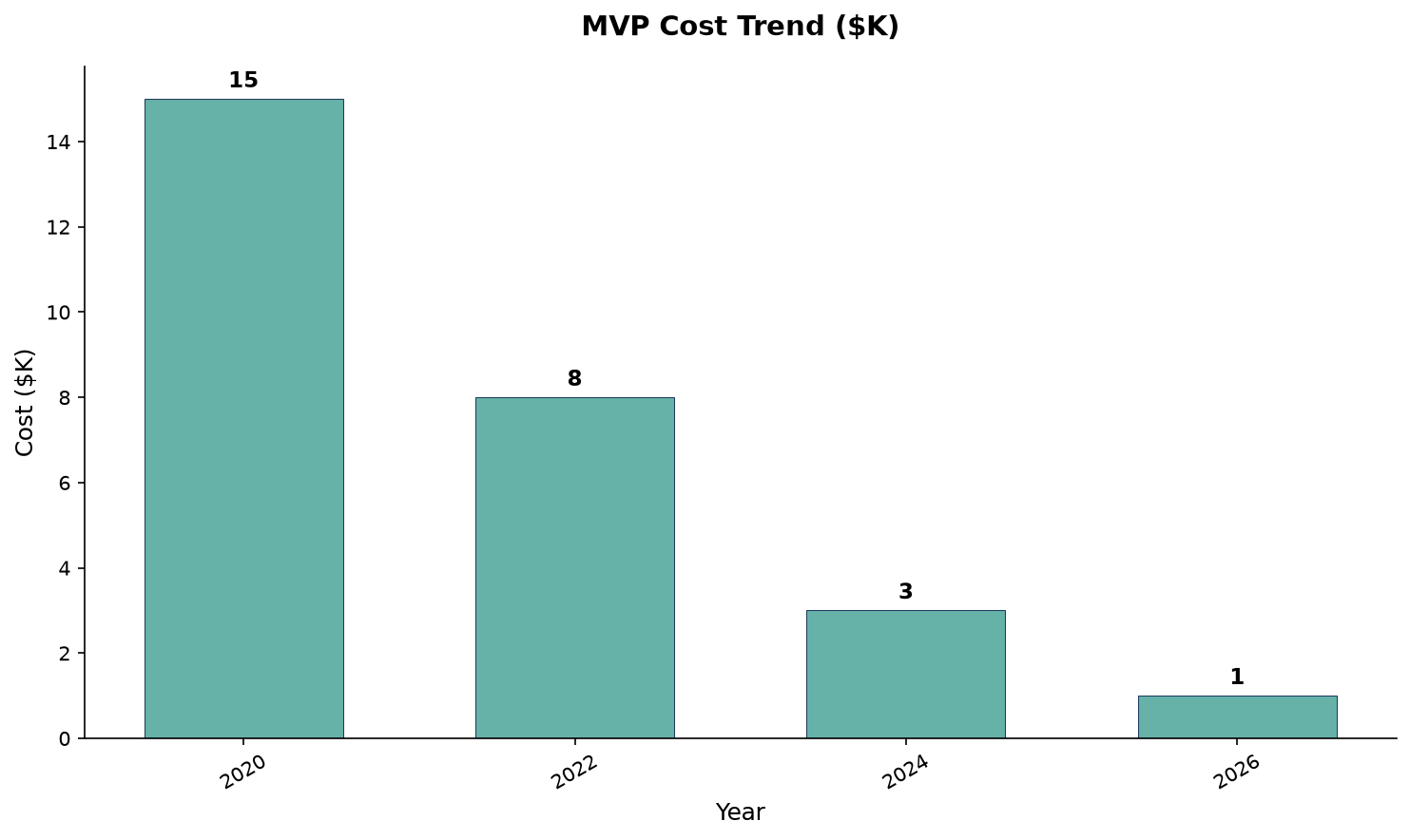
But the same forces that lower the barrier to entry also lower it for everyone else. More solo founders means more competition. The advantage no longer comes from knowing how to code — it comes from knowing what to build and for whom.
How High Is the Success Rate Really?
The honest answer is that most solo businesses still fail. But the failure pattern has shifted, and understanding it is the first step to avoiding it.
According to the Nasdaq Economic Institute’s July 2026 report, 94% of solopreneurs project business growth this year, and 71% report improved financial results compared to 2025. AI-enabled freelancers report 25% to 47% higher earnings and 25% to 40% faster delivery than their non-AI peers. Among newly launched solo-founded businesses, 65% cite AI tools as central to their go-to-market strategy from day one.
These numbers look encouraging, but they describe the survivors. The broader picture is that the majority of solo ventures never reach meaningful revenue. A 2025 Stripe-commissioned study found that among developers who launched a paid product independently, only 12% reached $1,000 MRR within twelve months, and just 3% crossed $10,000 MRR. What separates the ones that do? Research across multiple case studies yields a consistent formula:
Solo business revenue = Industry experience × AI leverage × Market selection
The three variables are multiplicative, meaning a zero in any category produces a zero overall. AI leverage is the easiest to acquire — tools are cheap and widely available. But leverage alone is not enough. Industry experience means you understand a specific domain’s pain points, workflows, and buying behavior well enough to build something that fits without guesswork. Market selection means choosing a segment where customers have budget and urgency, not just interest. Most founders have AI leverage. Few combine it with genuine industry depth and a market that is ready to pay.
The failure dynamics have also shifted. In 2020, solo businesses failed primarily because building was too expensive and shipping took too long. In 2026, they fail because marketing and distribution are the bottlenecks. Building is cheap, but getting noticed is harder than ever. The abundance of AI-generated products has flooded every distribution channel. This makes market selection and positioning more important, not less. A product that solves an urgent, niche problem with clear distribution channels has a dramatically higher survival rate than a well-built generic tool competing for attention on Product Hunt.
The playbook is not to bet everything on one product. The founders who consistently succeed operate a portfolio approach: one primary product as the revenue engine, one or two utility products as steady income streams, one knowledge product (courses, books), and a stream of small experiments. Tony Dinh, the Vietnamese solo developer behind TypingMind, runs this exact model and generates roughly $142,000 per month across four products with a 90% profit margin. Pieter Levels follows the same pattern with Photo AI, Interior AI, Nomad List, and several smaller projects, collectively generating over $3 million annually. For a practical guide on setting up your first automated workflow, see our AI automation guide for small business. The portfolio model insulates against any single product failing and allows capital-efficient cross-pollination of learnings and audiences.
How Do You Pick the Right Direction?
Direction selection is the decision that determines everything that follows. The data supports four rules that reduce the odds of building something nobody wants.
Rule 1: Solve a pain you have experienced yourself. Every successful solo product in the research started from the founder’s own frustration. SiteGPT emerged from Bhanu Teja’s need to add AI customer support to his earlier products. TypingMind was born from Tony Dinh’s dissatisfaction with existing ChatGPT interfaces. Interior AI came from Pieter Levels’ observation that real estate staging photography was expensive and slow. The common thread is not creativity — it is proximity to a real problem.
Rule 2: Go narrower than you think is reasonable. The most profitable solo businesses in 2026 serve microscopic niches. A developer built a $40,000-per-month AI coding assistant specifically for Godot, a game engine with roughly 10% of the indie market. He chose Godot over Unity specifically because the larger market had too many competitors and the smaller one had almost none serving it. His users had no alternatives, which meant his conversion rates held steady even as he raised prices from $15 to $39 per month.
The narrower the niche, the easier it is to dominate pricing and distribution. The “sweet spot” for micro-SaaS — $5,000 to $50,000 MRR with a one or two person team — is historically wide in 2026.
Rule 3: Choose a market that is growing faster than it is crowded. Absolute market size today matters less than growth rate over the next three years. A market growing at 2x annually gives you room to find positioning before well-funded competitors arrive. The Godot ecosystem grew precisely because Unity’s self-inflicted wounds in 2023 permanently pushed developers toward alternatives. The bet was not on current size but on trajectory.
Rule 4: Avoid “ChatGPT wrapper” markets. The 2026 market is ruthless to generic solutions. Users have learned to distinguish real value from a thin API call. A 2024-era “AI chatbot builder” that worked fine then is now competing with hundreds of identical products. The surviving solo products own a specific workflow, a specific integration, or a specific compliance requirement that makes replacement costly.
Case Study Walkthrough: From Zero to $40K MRR
To make these rules concrete, consider the trajectory of the Godot AI coding assistant mentioned earlier. The founder — a solo developer who had worked with Godot for years — did not start with the ambition of building a business. He started by scratching an itch: Godot’s built-in code completion was basic, and the official IDE integration had no AI features. He built a simple VS Code extension over a weekend using Claude-generated boilerplate, published it on the Godot Asset Library, and returned to his regular work.
The first signal came in week two: strangers began filing GitHub issues with genuine feature requests. By week four, the repository had 200 stars and several hundred weekly active users. Only then did he add a subscription tier: $15 per month for GPT-4-powered completions and context-aware refactoring.
The turning point was a Reddit post on r/godot that hit the front page of the Godot community. Overnight, paid users jumped from 40 to 200. At that moment, revenue was approximately $3,000 per month — barely a side-project income. He committed to full-time work at month three, when MRR crossed $8,000 and the growth rate was still accelerating.
By month six, MRR reached $28,000. At month twelve, it hit $40,000 with a single founder and no marketing spend beyond the original Reddit post. The key insight: the extension had zero direct competitors. Godot’s market share was small enough that no funded startup would target it, but large enough — roughly 1.5 million developers — to sustain a healthy solo business. The founder later raised prices to $39 per month to match the value delivered, and churn remained under 5%.
This pattern repeats across dozens of successful solo businesses in 2026: start with a personal need, validate through organic community engagement, monetize only after proven usage, and dominate a small market that is too niche for anyone else to attack.
How Do You Validate Without Wasting Months?
The single biggest mistake solo founders make is building before validating. In 2020, the high cost of building incentivized at least some upfront customer research. In 2026, the near-zero cost of building has the opposite effect: founders ship first and discover nobody cares later.
A 30-day validation framework, based on patterns from multiple successful solo launches, works as follows:
Week 1: Market research. Identify three to five potential niches. For each, study existing solutions, user complaints on Reddit and Hacker News, and pricing structures. The goal is not to confirm your idea is good — it is to find a gap that users are already complaining about. Use AI tools for competitive analysis and sentiment extraction.
Week 2: Customer conversations. Talk to at least 20 people in your target market before writing a line of code. The question is not “would you use this?” — everyone answers yes to that. Ask instead: “what is the most frustrating part of your current workflow?”
Week 3: MVP. Build the smallest possible version that delivers the core value. In 2026, this means one to two weeks of work and $500 to $2,000 in costs. Use Cursor or Claude Code for development. Use no-code tools (Bubble, Make) where appropriate. Do not build anything that is not directly related to the value proposition.
Week 4: First paying customers. Launch on Product Hunt, Hacker News, Reddit, or a relevant community. The minimum viability signal is not traffic — it is someone willing to enter a credit card number. Set a goal of three to five paying customers in the first month.
The timeline varies. Bhanu Teja’s SiteGPT hit 15,000 website visits on launch day and had ten paying customers within a month. Another solo founder, Niko, reported making his first sale on day 105. Both outcomes are valid — the critical signal is whether revenue grows month over month. If it does not by month three, the direction is wrong.
How Do You Grow from $1K to $50K MRR?
Once validation is confirmed, growth follows a predictable pattern that is well documented across successful solo businesses.
Pricing should be higher than you think. The most common solo founder mistake is underpricing. In the Godot AI assistant case, raising the price from $15 to $39 did not reduce conversion rates — it improved them, because higher pricing signaled seriousness. Interior AI runs at 99%+ margin after GPU costs. Tony Dinh’s four products average 90% margin. The economic advantage of solo operation is that there is no team to pay, and pricing should reflect the value delivered, not the cost of the founder’s time.
SEO is the highest-leverage channel. Coconote, an AI note-taking tool, grew to $6.7 million ARR in 18 months with almost zero paid advertising. Their secret was an SEO engine: the product auto-generated pages from hundreds of thousands of YouTube video transcriptions, capturing massive long-tail search traffic. The result was over 400,000 monthly organic visits. SEO compounds in a way that short-form video does not — content published today continues acquiring users months later.
Build a product portfolio, not a single product. The most resilient solo founders run multiple products simultaneously. Tony Dinh operates four: TypingMind ($137K/mo), DevUtils ($5K/mo), My Indie Book ($518/mo), and Image.Social ($50/mo). The flagship funds the experiments, and the experiments occasionally become new flagships. Pieter Levels runs a similar portfolio: Photo AI, Interior AI, Nomad List, and others.
Set thresholds for hiring. The solo model has a real ceiling made of judgment, relationships, and accountability. When your own time becomes the constraint — typically between $30K and $50K MRR — the question is not whether to hire but what to hire for. Add humans only where AI cannot reach: high-stakes judgment calls, enterprise relationship management, and accountability for things that cannot be automated.
What Business Models Work Best in 2026?
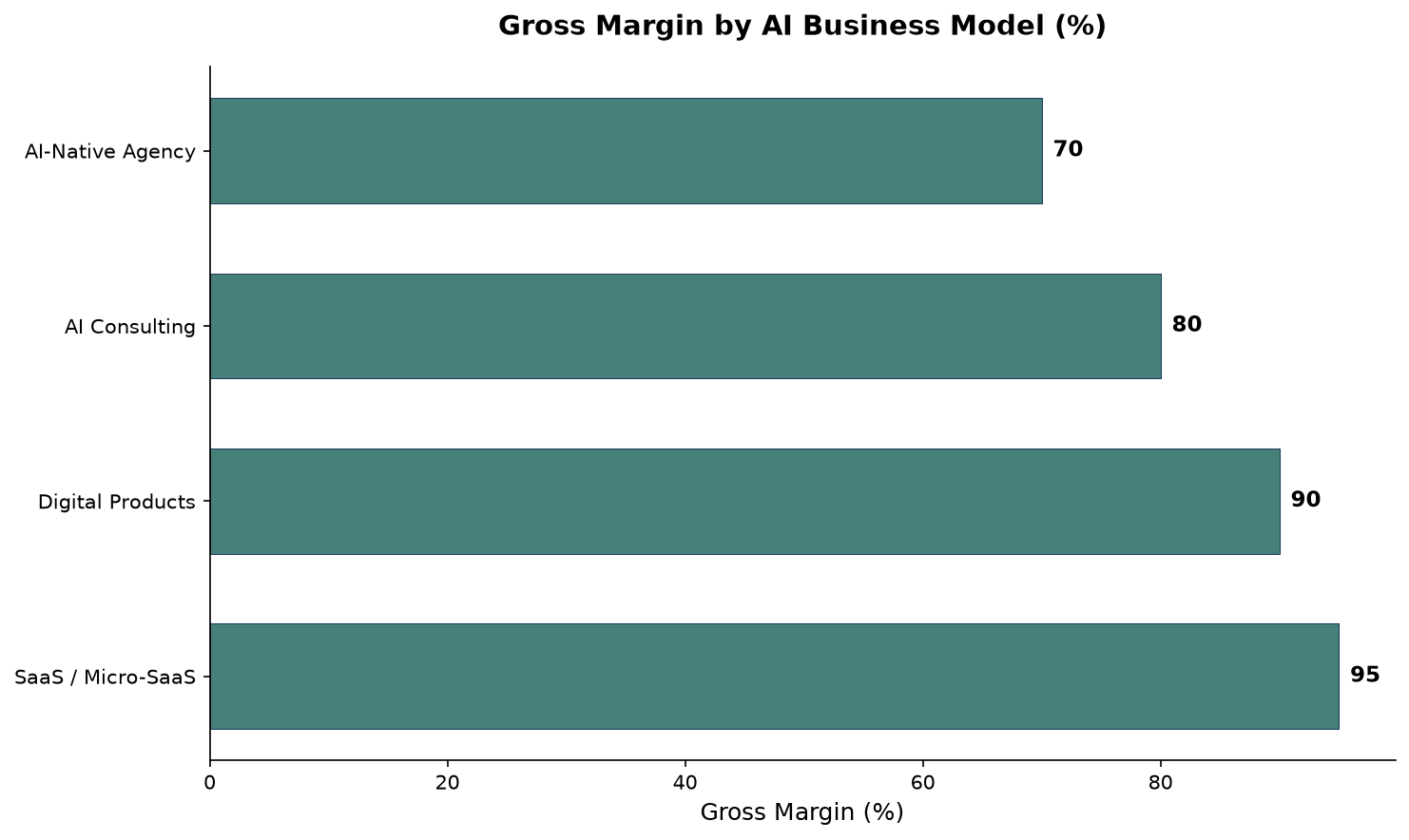
The data supports four primary models, ranked by gross margin and difficulty:
| Model | Gross Margin | Difficulty | Monthly Revenue Range | Best For |
|---|---|---|---|---|
| AI Software / Micro-SaaS | 95% | High | $10K–$100K+ | Technical founders |
| AI Digital Products | 90% | Medium | $5K–$30K | Domain experts |
| AI Consulting | 80% | Low | $3K–$20K | Industry veterans |
| AI-Native Agency | 70% | Low–Medium | $3K–$50K | Anyone |
The recommended upgrade path: start with services or consulting (70-80% margin) to build trust and learn real business needs, then productize repeatable workflows into SaaS to push margin toward 95%. This path matches the experience of most successful solo founders in the research.
When Should You Stop Going Solo?
The solo model is a stage, not an identity. The founders who succeed at it long-term treat it as a phase they will eventually outgrow.
The ceiling appears in three specific areas. Judgment under uncertainty: AI is good at executing faster but bad at deciding whether to execute at all. Strategic forks — which market, which customer, which feature to kill — sit entirely on the founder. Relationships: enterprise sales, partnerships, and fundraising run on trust between humans, and no AI agent can build that. Accountability: when AI ships something mediocre, only the founder catches it, and a tired solo founder catches less.
The data from case studies suggests that the $30K to $50K MRR range is where most successful solo founders begin adding humans. The first hire is rarely another engineer — it is someone to handle the judgment and relationship work that the AI stack cannot touch.
The solo founder era is real, and 2026 is the year it went mainstream. The tools work. The economics work. But the founders who win are not the ones who use AI best. They are the ones who combine AI leverage with genuine industry insight, narrow market selection, and the discipline to validate before building. The technology is the enabler. Everything else is still up to you.