
Featured image: Gavel resting on a digital circuit board, symbolizing AI law and regulation. Photo by Tara Winstead on Pexels (Free to use).
On August 2, 2026 — 26 days from this publication — the EU AI Act’s high-risk obligations become enforceable, activating the world’s most comprehensive AI regulatory framework with penalties reaching €35 million or 7% of global annual turnover. The same week, seven U.S. states have active AI-specific laws, China is enforcing its mandatory content labeling regime through coordinated campaigns that have already penalized over 13,000 accounts, South Korea’s AI Basic Act is six months into effect, and Japan’s AI Promotion Act provides a soft-law alternative.
This is not a future regulatory landscape. It is the present operating environment for any organization that develops, deploys, or distributes AI systems across multiple jurisdictions.
This report consolidates data from the EU AI Act (Regulation 2024/1689), the AI Law Tracker, Presenc AI’s policy tracker, White & Case’s global regulatory tracker, DLA Piper’s AI Laws of the World, China’s CAC enforcement records, South Korea’s AI Basic Act, Japan’s AI Promotion Act, and state-level legislative tracking to give you a single reference for AI regulation in mid-2026. For context on how AI regulation intersects with national security, see our analysis of the US government’s AI control efforts.
What Is the EU AI Act and When Does It Apply?
The EU AI Act is the world’s first comprehensive horizontal AI regulation. Adopted in June 2024 and published in August 2024, it establishes a risk-based classification framework that applies to any AI system placed on the EU market or whose output is used within the EU — regardless of where the provider is headquartered.
The Act’s structure rests on four risk tiers. Prohibited practices (Article 5) — social scoring, real-time remote biometric identification in public spaces, and AI systems that exploit vulnerabilities — have been enforceable since February 2, 2025. General-purpose AI model obligations have been operational since August 2, 2025. The critical deadline is August 2, 2026, when high-risk system requirements take full effect.
| Deadline | Obligation | Status |
|---|---|---|
| Feb 2, 2025 | Prohibited AI practices (Article 5) | Enforceable |
| Aug 2, 2025 | General-purpose AI model obligations | Enforceable |
| Aug 2, 2026 | High-risk AI system requirements (Annex III) | 26 days away |
| Aug 2, 2027 | High-risk AI in regulated products (Annex I) | Extended deadline |
Source: EU AI Act (Regulation 2024/1689), Official Journal of the European Union, August 2024. The Digital Omnibus package proposes delaying the Aug 2, 2026 deadline, but as of July 2026 it has not been formally adopted.
High-risk systems under Annex III cover eight categories: biometric identification and categorization, critical infrastructure management, education and vocational training, employment and worker management, access to essential services (including credit scoring and insurance underwriting), law enforcement, migration and border control, and administration of justice. Any organization deploying AI in these areas must meet 13 specific obligations, including risk management systems (Article 9), data governance (Article 10), technical documentation (Article 11), logging (Article 12), transparency (Article 13), human oversight (Article 14), and accuracy/robustness/cybersecurity (Article 15).
For most organizations deploying high-risk AI, the four most operationally demanding obligations are: establishing a continuous risk management process that covers the entire AI system lifecycle; ensuring training, validation, and test data are relevant, representative, and free from bias; implementing human oversight mechanisms that allow operators to override or deactivate the system at any point; and maintaining automatic event logs that enable traceability of system operation. Conformity assessment for most Annex III systems can be conducted through self-assessment, but systems intended for remote biometric identification require assessment by an external notified body.
What Are the EU AI Act Penalties?
Article 99 establishes a three-tier penalty framework. The fines are the higher of the fixed amount or the percentage of worldwide annual turnover:
| Tier | Violation | Maximum Fine | Effective Since |
|---|---|---|---|
| 1 | Prohibited AI practices (Article 5) | €35M or 7% of global turnover | Feb 2, 2025 |
| 2 | Non-compliance with provider/deployer obligations | €15M or 3% of global turnover | Aug 2, 2026 |
| 3 | Supplying incorrect information to authorities | €7.5M or 1.5% of global turnover | Aug 2, 2026 |
Source: EU AI Act, Article 99. Penalties are the second-highest percentage-based fines in EU digital regulation, behind only the Digital Markets Act.
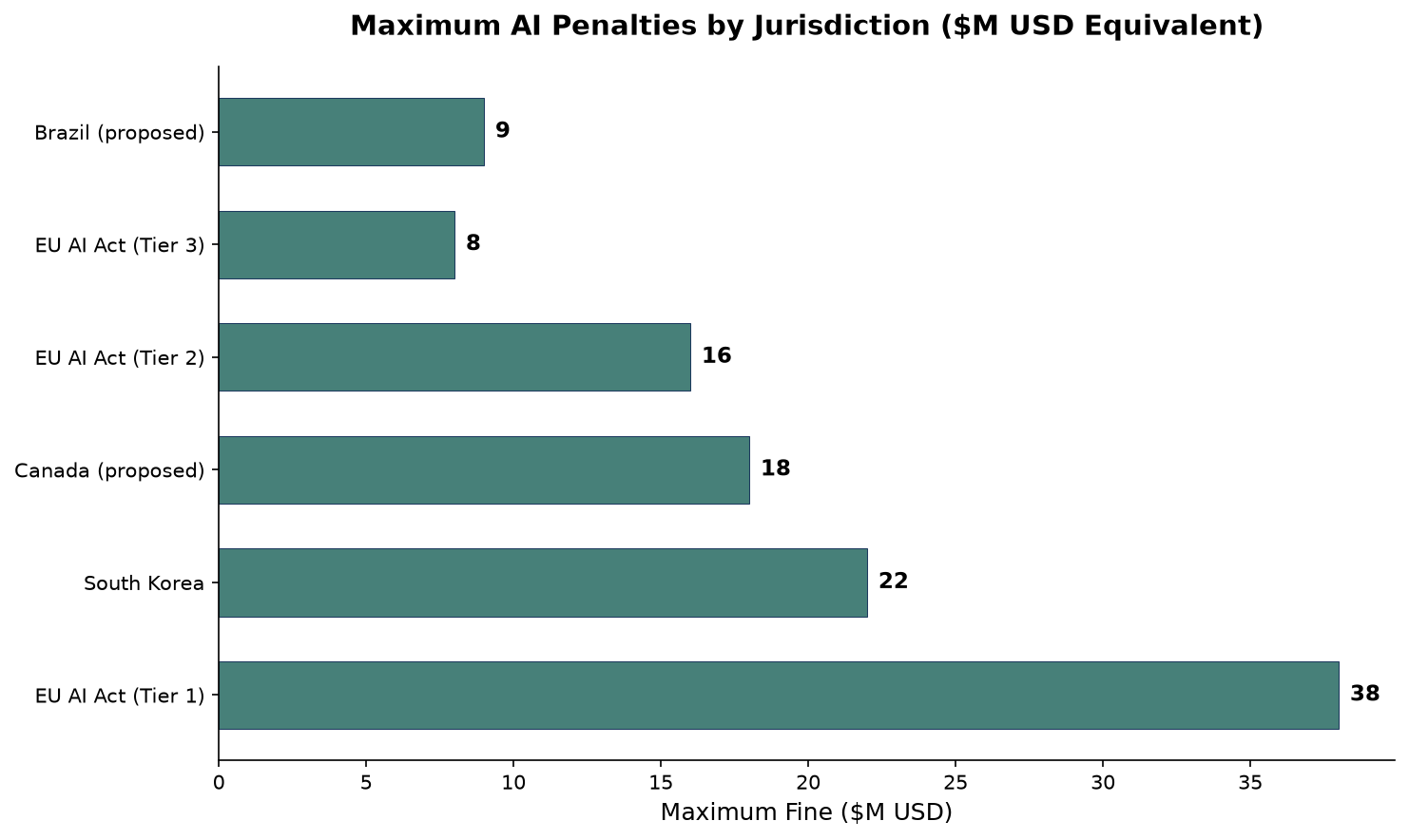
The EU AI Office is operational and exercising oversight for general-purpose AI models. National market surveillance authorities across all 27 member states will enforce high-risk obligations. For US companies, enforcement flows through their EU authorized representative, EU business partners, or direct investigation triggered by incidents or complaints. The practical implication: a US-based SaaS company whose AI-powered hiring tool evaluates EU residents must comply with Annex III employment provisions even if the company has no physical presence in Europe. Many of these regulated systems are AI agents deployed in production, which face simultaneous obligations under multiple frameworks.
Which US States Have Active AI Laws?
The United States has no comprehensive federal AI statute as of July 2026. Instead, AI governance operates through sectoral federal enforcement (FTC Section 5, EEOC Title VII, CFPB, HHS) and an increasingly active state legislative landscape. The Trump administration’s December 11, 2025 executive order asserts federal preemption over state laws that compel AI models to alter truthful outputs, and three state laws (Colorado, New York, Illinois) face active federal litigation as of Q2 2026.
Seven U.S. states currently enforce AI-specific laws against businesses as of July 2026, with Colorado’s comprehensive AI Act pushed to 2027:
| State | Law | Effective Date | Scope |
|---|---|---|---|
| California | AI Transparency Act (SB 942) | Jan 1, 2026 | Watermarking and disclosure for AI-generated content |
| California | GenAI Training Data Transparency Act (AB 2013) | Jan 1, 2026 | Training data disclosure requirements |
| Texas | Responsible AI Governance Act (TRAIGA) | Jan 1, 2026 | Cross-sector deployer obligations (broadest state scope) |
| Illinois | HB 3773 (Employment AI) | Jan 1, 2026 | AI systems used in employment decisions |
| Utah | Artificial Intelligence Policy Act (SB 149) | May 1, 2024 | Disclosure for regulated occupations |
| Tennessee | ELVIS Act | July 1, 2024 | Voice and likeness protection against AI cloning |
| New York City | Local Law 144 | July 5, 2023 | Bias audits for automated employment decision tools |
Source: Presenc AI policy tracker, AI Law Tracker, Cooley, King & Spalding, as of July 2026. Colorado’s SB 24-205 was stayed by a federal magistrate on April 27, 2026; a replacement bill (SB 189) passed in May 2026.
The bigger picture: 45 states have introduced 1,561 AI-related bills as of March 2026, per multistate.ai. The federal-state preemption fight is the dominant U.S. policy story. If the DOJ wins its preemption challenges, state AI laws weaken substantially — compliance would simplify to sectoral federal rules enforced by FTC, EEOC, CFPB, and HHS. If the states prevail, the regulatory landscape becomes the patchwork vendors have been bracing for since 2023, with potentially different requirements in every state where they operate.
What Is China’s AI Regulatory Approach?
China has the densest stack of AI-specific rules globally, built through targeted regulations issued one by one rather than a single omnibus law. A comprehensive national AI law is under “legislative research” but no draft exists — earliest enactment is 2027.
The most immediately impactful regulation is the AI Content Labeling Measures, effective September 1, 2025, enforced through a coordinated campaign by four agencies (CAC, MIIT, MPS, SAMR). On February 12, 2026, the CAC penalized 13,421 accounts and removed 543,000 content pieces for failing to label AI-generated material. The Qinglang 2026 campaign has since processed 39,000+ accounts and 708,000+ AI content pieces.
| Regulation | Effective | Scope |
|---|---|---|
| Algorithmic Recommendation Rules | Mar 1, 2022 | Recommendation algorithm transparency |
| Deep Synthesis Regulations | Jan 10, 2023 | Deepfake/synthetic media labeling |
| Generative AI Services Measures | Aug 15, 2023 | Licensing for public-facing GenAI |
| AI Content Labeling Measures | Sep 1, 2025 | Dual labeling (visible + metadata) for all AI content |
| GB 45438-2025 (mandatory standard) | Sep 1, 2025 | Technical watermark specs, metadata encoding |
| Facial Recognition Measures | Jun 1, 2025 | On-device storage mandate |
| Foundation Model Regulation (draft) | Expected 2026 | Capability-tier obligations |
Source: Reg Intel, CAC enforcement records, GB 45438-2025 standard, as of July 2026.
China’s labeling requirement is the most detailed in the world. Layer 1 requires visible labels — text, audio cues, or graphic overlays that users immediately recognize. Layer 2 requires embedded metadata — hidden watermarks containing the provider’s name, unique content identifier, and encrypted data that survives compression, cropping, and redistribution. Platforms must detect incoming content and classify it into three tiers (confirmed, possible, or suspected AI-generated).
The penalties are operational: account suspension, content removal, and criminal referral for serious violations. The February 2026 enforcement action showed the CAC is willing to act at scale — 13,421 accounts in a single wave. Foreign AI service providers whose content reaches Chinese users are subject to these rules regardless of where the provider is headquartered. The practical implication for international developers: any AI product that generates text, images, audio, or video accessible to users in mainland China must implement dual labeling and maintain compliance documentation, including six-month retention logs for unlabeled content delivered at user request.
How Do Other Major Economies Compare?
Beyond the EU, US, and China, several major economies have established distinct regulatory models that range from comprehensive legislation to sector-specific guidance:
| Country | Regime Type | Effective | Key Features |
|---|---|---|---|
| South Korea | AI Basic Act (comprehensive) | Jan 22, 2026 | Risk-based, high-impact AI category, impact assessments, transparency |
| Japan | AI Promotion Act (soft-law) | Sep 2025 | Voluntary guidelines, METI principles, innovation-focused |
| United Kingdom | Principles-based (no AI Act) | Active | 5 principles enforced by sector regulators (FCA, Ofcom, ICO) |
| Canada | No federal AI Act (AIDA lapsed) | Stalled | Quebec Law 25 governs automated decisions |
| Brazil | PL 2338/2023 (draft) | Expected 2026-2027 | Structural EU mirror with adapted thresholds |
| Australia | Mandatory guardrails (draft) | Expected 2026-2027 | Transitioning from voluntary to binding |
| India | IT Rules amendment | Feb 2026 | 2-3 hour takedown deadlines for synthetic content |
| Vietnam | AI Law | Mar 1, 2026 | First standalone SEA AI law, risk-based labeling |
| Saudi Arabia | PDPL + SDAIA principles | Active | Data protection framework governing AI |
| UAE | Strategy-led | Active | No dedicated AI Act; binding data protection law |
Sources: DLA Piper AI Laws of the World, White & Case global regulatory tracker, AI Law Tracker, as of July 2026. Note that the UK, Japan, and Singapore take principles-based approaches that impose fewer direct compliance obligations than the EU or China but require documented governance processes nonetheless. Canada’s AIDA remains stalled with no clear path to passage in 2026.
Global Penalty Comparison
| Jurisdiction | Maximum Financial Penalty | Extraterritorial |
|---|---|---|
| EU AI Act | €35M or 7% of global turnover | Yes — if output used in EU |
| South Korea | KRW 30B (~$22M) or 3% of revenue | Yes — affects Korean residents |
| Brazil (proposed) | R$50M or 2% of Brazilian revenue | Under discussion |
| Canada AIDA (stalled) | CAD $25M or 5% of global revenue | Proposed |
| China | Account suspension, content removal, criminal referral | Yes — content reaching Chinese users |
| Colorado AI Act (stayed) | CCPA enforcement (varies) | Applies to Colorado residents |
| NYC LL 144 | $500-$1,500 per violation per day | NYC-based applicants |
Sources: EU AI Act Article 99, Korean AI Basic Act, DLA Piper global tracker, Presenc AI. Penalty structures vary substantially — EU has highest percentage-based fines; China relies on operational penalties rather than fixed fines.
| Jurisdiction | First Binding Law | Year | Type |
|---|---|---|---|
| China | Algorithmic Recommendation Rules | 2022 | Technology-specific regulation |
| China | Deep Synthesis Regulations | 2023 | Technology-specific regulation |
| EU | AI Act (adopted) | 2024 | Comprehensive horizontal regulation |
| Japan | AI Promotion Act | 2025 | Soft-law / principles-based |
| South Korea | AI Basic Act | 2026 | Comprehensive horizontal regulation |
How Should Organizations Prioritize Compliance by Risk Tier?
The regulatory burden varies dramatically by application type. Organizations should classify their AI systems into risk tiers that map to enforcement timelines:
| Risk Tier | Examples | Regulated By | Deadline |
|---|---|---|---|
| Prohibited | Social scoring, real-time biometric surveillance in EU | EU AI Act | Already enforceable |
| High-risk | Credit scoring, hiring tools, insurance underwriting, law enforcement AI | EU AI Act (Annex III), CA/TX/IL state laws, China GenAI rules | EU: Aug 2, 2026; US states: Already in effect |
| Limited-risk | Chatbots, AI content generation | EU Art. 50 transparency, China labeling rules, Japan guidelines | EU: Aug 2, 2026; China: Already in effect |
| Minimal-risk | AI-enabled spreadsheets, spam filters | None (currently exempt in most jurisdictions) | N/A |
What Does This Mean for the Second Half of 2026?
Three developments will define the remainder of 2026.
First, the EU AI Act’s August 2 deadline creates a forced compliance event for any organization using AI in high-risk categories within the EU market. Even if the Digital Omnibus ultimately delays the deadline, the penalty for assuming a delay that does not materialize is enforcement without preparation. The asymmetry is clear: prepare now and gain extra time if delayed; wait and risk non-compliance fines up to 7% of global turnover.
Second, the US federal-state preemption battle will reach a legal resolution point. If the DOJ prevails, the US regulatory landscape simplifies to sectoral federal enforcement. If states prevail, companies face 50 different compliance regimes — a scenario that would accelerate calls for federal preemptive legislation.
Third, China is positioning its synthetic content labeling regime as a model for other jurisdictions, with active diplomatic engagement around the rules in BRICS+ markets. The combination of mandatory dual labeling, technical standards, and coordinated enforcement campaigns represents the most operationally detailed AI compliance framework in the world.
The bottom line for July 2026: AI regulation is no longer theoretical. Eleven jurisdictions have binding AI-specific laws in effect. Penalties reach 7% of global turnover. The compliance burden is distributed unevenly — an AI hiring tool faces simultaneous obligations under the EU AI Act (Annex III employment), California’s AI Transparency Act, Illinois HB 3773, and potentially China’s labeling rules if the tool is used there. The organizations that treat compliance as a strategic investment rather than a cost will navigate the fragmented landscape more effectively than those waiting for consolidation that may not arrive. The most practical first step: conduct an AI system inventory, classify each system by risk tier, map it to the jurisdictions where it operates, and begin documenting compliance evidence for the highest-risk systems first.