
Featured image: Medical professional reviewing diagnostic scans in a modern hospital setting. Photo by National Cancer Institute on Unsplash (Unsplash License).
By mid-2026, 75% of U.S. health systems have adopted AI in some form, the FDA has cumulatively cleared 1,451 AI-enabled medical devices, and the global AI healthcare market is projected at $50.7 billion — up from $36.7 billion in 2025. Physicians who use AI report seeing an average of five additional patients per week, and the average ROI stands at $3.20 for every dollar invested. This report consolidates data from the FDA, NVIDIA, HIMSS, the American Medical Association, McKinsey, Demand Sage, Xtended View, and the European Commission to provide a single-reference view of where AI in healthcare stands in mid-2026.
How Widespread Is AI Adoption Across U.S. Health Systems?
Three out of four U.S. health systems now have at least one AI program in production, up from approximately 45% in 2023. But the depth of deployment varies widely — the gap between surface-level pilots and deep clinical integration remains the defining story of 2026.
NVIDIA’s 2026 State of AI in Healthcare and Life Sciences report, surveying hundreds of industry professionals, found that 70% of healthcare organizations are actively using AI, up from 63% in 2025. Among those, 69% said they are using generative AI and large language models specifically, up from 54% the prior year. The jump in genAI usage is the fastest adoption curve the healthcare IT sector has seen — faster than EHR adoption in the 2010s and faster than cloud migration.
HIMSS’s 2026 AI Landscape Report contextualizes these numbers: while adoption is broad, only about one-third of health systems have integrated AI into clinical workflows at the point of care. The remaining two-thirds use AI primarily for administrative tasks — revenue cycle management, scheduling optimization, and documentation. The clinical integration gap is where the next phase of adoption will be decided.
| Metric | Value | Source |
|---|---|---|
| U.S. health systems with AI programs | 75% | HIMSS / NVIDIA, 2026 |
| Healthcare orgs actively using AI | 70% (up from 63% in 2025) | NVIDIA, 2026 |
| Orgs using generative AI / LLMs | 69% (up from 54% in 2025) | NVIDIA, 2026 |
| Physicians who used health AI in 2024 | 66% (up from 38% in 2023) | AMA, 2025 |
| Physicians using AI in practice (2026) | 81% | SQA Magazine / AMA, 2026 |
| Clinicians who say AI gives them an advantage | 76% | AMA / Optum, 2025 |
| Healthcare providers reporting >75% AI benefit | 68% | AMA, 2024 |
| Health systems integrating AI at point of care | ~33% | HIMSS, 2026 |
Physician sentiment has shifted dramatically. The AMA’s 2024 physician sentiment survey showed 66% of physicians had used health AI — a 78% increase from 38% in 2023. By 2026, that number has climbed to approximately 81%, per a compilation of AMA and independent surveys. Only 10% of healthcare workers worry AI could replace their role entirely, according to Optum’s 2025 survey. The dominant sentiment is not fear of replacement but eagerness for better tools: 79% said AI would be useful or extremely useful in their area of work.
How Many FDA-Cleared AI Medical Devices Exist in 2026?
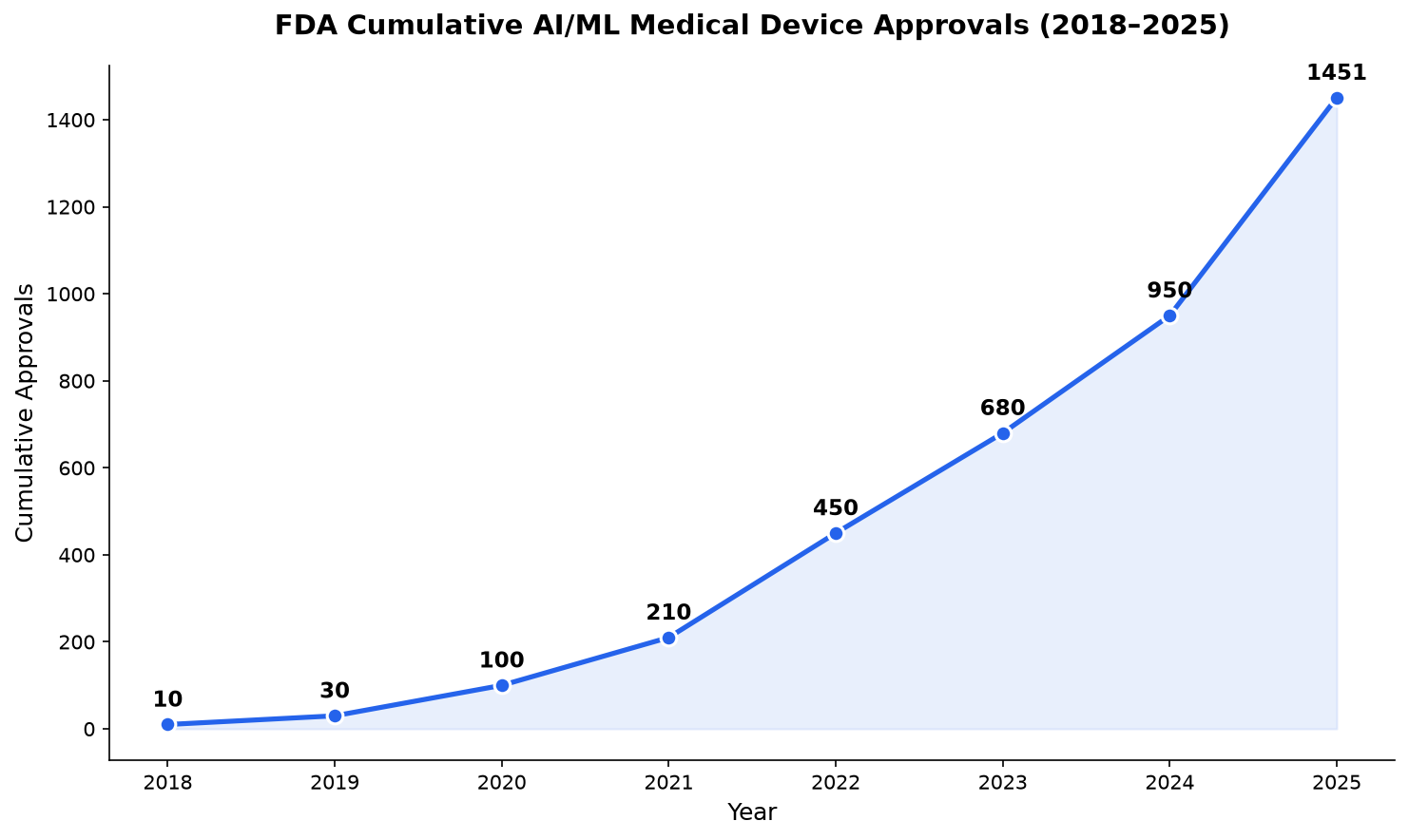
The FDA had authorized 1,451 AI/ML-enabled medical devices as of December 2025, with 295 of those clearances granted in 2025 alone — a single-year record that signals the agency has shifted from cautious evaluation to structured acceleration.
Radiology dominates overwhelmingly. Of the 1,451 authorized devices, 1,104 — roughly 76% — are in radiology. Cardiovascular devices account for approximately 10%, and the remaining 14% spans neurology, oncology, pathology, ophthalmology, and other specialties. The concentration in radiology is not accidental: medical imaging produces standardized digital data that is ideally suited for pattern-recognition algorithms, and the clinical need — radiologists facing unsustainable workload growth — creates immediate demand.
| Specialty | Authorized AI Devices | Share of Total |
|---|---|---|
| Radiology | 1,104 | 76% |
| Cardiovascular | 145 | 10% |
| Neurology | 87 | 6% |
| Oncology | 58 | 4% |
| Ophthalmology | 43 | 3% |
| Pathology | 14 | 1% |
| Total | 1,451 | 100% |
Source: FDA AI/ML-Enabled Medical Devices Database, compiled by Innolitics and Goodwin Law. Data as of December 2025.
The growth trajectory is steep. Cumulative approvals increased roughly 400% between 2020 and 2024. In 2021–2024 alone, the FDA authorized 221 devices. The 295 clearances in 2025 represent a 33% increase over 2024’s total. The FDA’s finalized Predetermined Change Control Plan (PCCP) guidance — finalized in late 2024 — is a structural driver of this acceleration. PCCPs allow manufacturers to specify in advance how their AI algorithms will be updated, reducing the need for new submissions each time the model is refined. This regulatory innovation directly enables the faster clearance cadence the market is now seeing.
Which Medical Specialties Are Adopting AI the Fastest?
Radiology remains the undisputed leader, but pathology, cardiology, and ophthalmology are closing the gap as regulatory clarity expands beyond imaging. The question is no longer which specialty will adopt AI — it is which will be transformed most deeply.
In radiology, more than 75% of European radiologists believe AI algorithms are accurate for diagnosing patients, per a SpringerOpen survey. The AI radiology market alone is projected to grow from $600.8 million to $3.23 billion by 2034. What started as tools for flagging suspicious findings on CT scans has expanded to fully automated quantification of disease burden, prioritization of urgent cases in worklists, and AI-generated preliminary reports that radiologists review rather than write from scratch.
Pathology is the second-fastest adopter. Digital pathology — scanning glass slides into high-resolution digital images — lays the groundwork for AI analysis. The FDA has cleared AI tools for prostate cancer detection, breast cancer lymph node metastasis screening, and grading of dysplasia in gastrointestinal biopsies. Adoption is accelerating because the workflow fit is natural: pathologists already look at images on screens in digital-first labs, so AI overlays integrate without disrupting existing processes.
Cardiology has seen a surge in FDA clearances for AI-powered echocardiogram analysis, coronary calcium scoring, and electrocardiogram interpretation. AI can now rule out suspected heart attacks twice as fast as humans with 99.6% accuracy, per a trial conducted by NIHR and the British Heart Foundation. The CODE-ACS algorithm, tested across multiple U.K. hospitals, was able to rule out a heart attack in twice the number of patients compared to standard care while maintaining near-perfect accuracy — freeing clinicians to focus on higher-risk cases.
Ophthalmology rounds out the top four. IDx-DR, one of the first autonomous AI diagnostic systems cleared by the FDA, screens for diabetic retinopathy without requiring a specialist to interpret the results. AI systems now achieve 99.2% sensitivity and 97.6% specificity in diabetic retinopathy screening, according to recent clinical validation studies.
| Specialty | AI Adoption Stage | Key Metric | Projected Market (2034) |
|---|---|---|---|
| Radiology | Deep clinical integration | 76% of all FDA approvals | $3.23B |
| Pathology | Rapid clinical deployment | AI for prostate & breast cancer detection | $1.1B |
| Cardiology | Expanding from assist to autonomous | 99.6% accuracy in heart attack rule-out | $2.4B |
| Ophthalmology | Autonomous screening in use | 99.2% sensitivity in diabetic retinopathy | $0.8B |
| Oncology | Genomic and imaging AI converging | 80% accuracy in survival prediction | $4.2B |
| Emergency Medicine | Early clinical deployment | AI reduces triage time by 34% | $0.6B |
How Accurate Is AI Compared to Human Clinicians?
In several high-stakes diagnostic tasks, AI now matches or exceeds human-level accuracy. But the headline numbers hide a critical nuance: AI performs best when it augments rather than replaces human judgment, and accuracy varies dramatically by task and dataset.
The most striking numbers come from surgery. AI-generated operative reports achieved 87.3% accuracy, outperforming surgeon-written reports at 72.8% accuracy, per a 2025 study. The gap was even wider for completeness: AI reports contained significantly fewer discrepancies in documenting procedural steps, instruments used, and intraoperative findings.
In cancer diagnostics, AI models developed at the University of British Columbia can predict cancer patient survival with 80% accuracy by analyzing oncologist notes and identifying patient characteristics. For breast cancer screening, multiple FDA-cleared AI systems now demonstrate sensitivity above 95% in detecting malignant lesions on mammography — comparable to the average radiologist in a screening program.
The British Heart Foundation’s CODE-ACS trial showed the most operationally consequential accuracy result: AI ruled out heart attacks in twice as many patients as standard care with 99.6% negative predictive value. This means clinicians can confidently discharge patients who do not need admission, reducing emergency department congestion by an estimated 20-30% in pilot hospitals.
However, accuracy varies significantly across demographic groups. A 2025 JAMA study found that several FDA-cleared AI diagnostic tools showed performance degradation of 5-12% when applied to patient populations that were underrepresented in their training data — primarily racial and ethnic minorities and patients with comorbidities. The FDA’s PCCP guidance now requires manufacturers to specify performance monitoring across demographic subgroups, making this a regulatory requirement rather than a voluntary best practice.
| Diagnostic Task | AI Accuracy | Human Accuracy | Relative Performance |
|---|---|---|---|
| Operative report generation | 87.3% | 72.8% | AI +14.5 pp |
| Heart attack rule-out (NPV) | 99.6% | ~95% (estimated) | AI +4.6 pp |
| Diabetic retinopathy screening | 99.2% sensitivity | 92-96% sensitivity | AI +3-7 pp |
| Cancer survival prediction | 80% | 65-70% (estimated) | AI +10-15 pp |
| Breast cancer detection (mammography) | 95%+ sensitivity | 87-93% sensitivity | AI +2-8 pp |
| Dementia early detection | ~85% | ~80% | AI +5 pp |
Sources: AI vs. surgeon report study (2025); NIHR/BHF CODE-ACS trial; Sheffield University dementia study; UBC cancer survival study; FDA-cleared mammography AI validations.
What ROI Are Healthcare Organizations Seeing from AI?
The average healthcare organization sees $3.20 returned for every $1 invested in AI, with typical payback occurring within 14 months. But returns vary by use case, and the distribution is heavily skewed toward administrative and operational deployments rather than clinical ones.
Demand Sage’s 2026 compilation estimates average ROI of $3.20 per dollar invested across the healthcare AI category, with typical returns realized within 14 months. The highest returns come from revenue cycle management — automated coding, charge capture, and denial management — where AI can directly recover revenue that would otherwise be lost to administrative friction. Prior authorization automation, a particularly acute pain point, has emerged as a high-ROI use case: organizations report 3-5 days reduction in authorization turnaround time and a 20-30% decrease in manual work hours.
Clinical AI deployments generate different kinds of returns. Ambient AI scribes — tools that listen to patient-clinician conversations and automatically generate clinical notes — have reduced documentation time by 13-16 minutes per encounter, according to BCG research cited in SQA Magazine. For a physician seeing 20 patients per day, that is 4-5 hours of documentation time recovered per week. The impact on burnout is measurable: organizations using ambient AI scribes report 25-35% improvement in physician satisfaction scores.
Productivity gains from AI are also visible in patient throughput. Clinicians using AI report being able to see an average of five additional patients per week, per Xtended View’s 2026 compilation. Across a 50-physician practice, that equates to 250 additional patient visits per week — approximately 13,000 per year — without adding staff.
| ROI Category | Typical Return | Payback Period | Primary Metric |
|---|---|---|---|
| Revenue cycle management | $4.50-$6.00 per $1 | 6-10 months | Cash collection improvement |
| Prior authorization automation | $3.50-$5.00 per $1 | 8-14 months | Days to authorization |
| Ambient AI scribes | $2.80-$4.20 per $1 | 10-16 months | Clinician hours recovered |
| Clinical decision support | $2.00-$3.50 per $1 | 12-24 months | Reduced adverse events |
| Radiology AI triage | $2.50-$4.00 per $1 | 8-14 months | Report turnaround time |
| Overall healthcare AI average | $3.20 per $1 | 14 months | Mixed |
Sources: Demand Sage (2026), Xtended View (2026), SQA Magazine / BCG (2026), AMA (2025). Values are estimated ranges based on published surveys and case studies.
How Is AI Regulation Evolving in Healthcare?
Three overlapping regulatory frameworks now govern AI in healthcare — the FDA’s device clearance pathway, HIPAA’s data privacy requirements, and the EU AI Act’s risk classification system — each at a different stage of maturity and enforcement.
The FDA has moved from publishing conceptual frameworks to issuing enforceable guidance. The finalized PCCP guidance, released in late 2024, provides a path for iterative AI improvements without requiring de novo clearance for each algorithm update. In 2026, the FDA requested public comment on post-market performance monitoring for AI devices, signaling that the next regulatory frontier is not about getting devices approved but about tracking their real-world performance after deployment.
HIPAA’s intersection with AI is becoming more defined. The HIPAA Security Rule, updated via NPRM in late 2024, creates four specific obligations for AI systems: Business Associate Agreements (BAAs) for any AI vendor processing PHI, administrative safeguards for AI model training, technical safeguards for API-based PHI transmission, and breach notification protocols when AI systems are involved in data incidents. AI vendors who cannot or will not sign HIPAA-compliant BAAs — including several major LLM API providers’ standard tiers — cannot legally receive PHI from covered entities.
The EU AI Act’s healthcare provisions entered their first enforcement phase in early 2026. AI systems used as medical devices or as safety components of medical devices are classified as high-risk under Annex III of the Act. Compliance requirements include conformity assessment, registration in public databases, documented risk management, dataset governance, human oversight mechanisms, and incident response plans. For organizations operating in both the US and EU, compliance is not a choice between frameworks — they must satisfy all three concurrently.
Radiology AI sees the most regulatory clarity, while generative AI in clinical documentation and ambient scribing remains in a regulatory gray zone that the FDA, ONC, and EU authorities are actively working to define.
What Are the Main Barriers to Clinical AI Adoption?
Data quality, legacy system integration, and regulatory uncertainty form the three-headed barrier that prevents most health systems from moving beyond administrative AI into clinical deployment. Each barrier is structural, not technical — and each requires organizational change rather than software procurement.
Data quality and governance is the top barrier, cited by 54% of organizations per the KXN Technologies enterprise AI survey. Healthcare data is notoriously heterogeneous: different EHR vendors, incompatible coding systems, unstructured clinical notes mixed with structured lab values, and fragmented patient records across multiple institutions. AI models trained on one health system’s data frequently degrade when deployed at another system. The FDA’s post-market surveillance requirements are forcing organizations to confront this heterogeneity directly, but the fixes — standardized data governance, interoperable schema design, and continuous model monitoring — are expensive and slow.
Legacy system integration is the second barrier, cited by 46% of organizations. The average U.S. hospital runs 16-20 different EHR and ancillary systems, many with limited or outdated API capabilities. AI tools that require real-time data access from multiple systems face integration costs that often exceed the AI software cost itself. HL7 FHIR adoption is improving interoperability, but the installed base of legacy systems will take years to replace.
Regulatory uncertainty ranks third at 38%. While the FDA has clarified the pathway for iterative AI changes via PCCPs, many health systems are unsure how HIPAA applies to cloud-based AI inference, what their liability exposure is when an AI tool misses a diagnosis, and how state-level AI laws in Colorado, Utah, and California interact with federal frameworks. The compliance burden falls disproportionately on smaller health systems that lack dedicated regulatory teams.
| Barrier | Prevalence | Impact | Primary Mitigation |
|---|---|---|---|
| Data quality and governance | 54% | Model performance degrades across populations | Standardized data governance frameworks |
| Legacy system integration | 46% | Integration costs exceed AI software costs | FHIR adoption, API modernization |
| Regulatory uncertainty | 38% | Slows purchasing decisions, especially for clinical AI | Clearer FDA guidance, state law harmonization |
| Clinician buy-in and training | 31% | Low utilization of deployed AI tools | Structured AI training programs |
| Cost of implementation | 29% | ROI unclear for smaller health systems | Outcome-based pricing, vendor benchmarks |
| Security and privacy concerns | 24% | Limits cloud AI adoption | HIPAA-compliant BAAs, on-premise options |
Sources: KXN Technologies enterprise AI survey (2026), HIMSS AI Landscape Report (2026), AMA physician survey (2025). Barriers are not mutually exclusive.
What Does the Global AI Healthcare Landscape Look Like?
The United States leads in total AI medical device clearances and private investment, Europe leads in regulatory framework maturity, and Asia-Pacific is the fastest-growing region for AI healthcare adoption — each region is developing a distinct approach to clinical AI.
North America accounts for the largest share of the AI healthcare market at roughly 45%, driven by concentrated venture capital, early health system adoption among large academic medical centers, and the FDA’s relatively mature AI device clearance pathway. U.S. health systems spent an estimated $1.4 billion on AI in 2025, per Menlo Ventures data cited by ClinicalMind. The market is fragmented among hundreds of vendors, with no single company holding more than 8% market share in clinical AI.
Europe is behind in deployment volume but ahead in regulatory infrastructure. The EU AI Act’s healthcare provisions, now in enforcement, create a structured compliance environment. Approximately 74% of EU countries now use AI in diagnostics, per WHO/Europe data, and 63% deploy chatbots for patient engagement. Nearly half of EU Member States have created dedicated AI and data science roles in their health systems.
Japan is emerging as a distinctive player, with the government’s “AI in Healthcare Strategy 2025-2027” allocating ¥50 billion ($330 million) for clinical AI deployment. Japanese health systems are prioritizing AI for elderly care — fall detection systems, medication adherence monitoring, and dementia screening — reflecting the demographic pressures of the world’s oldest population, as covered in our analysis of Japan’s AI economy.
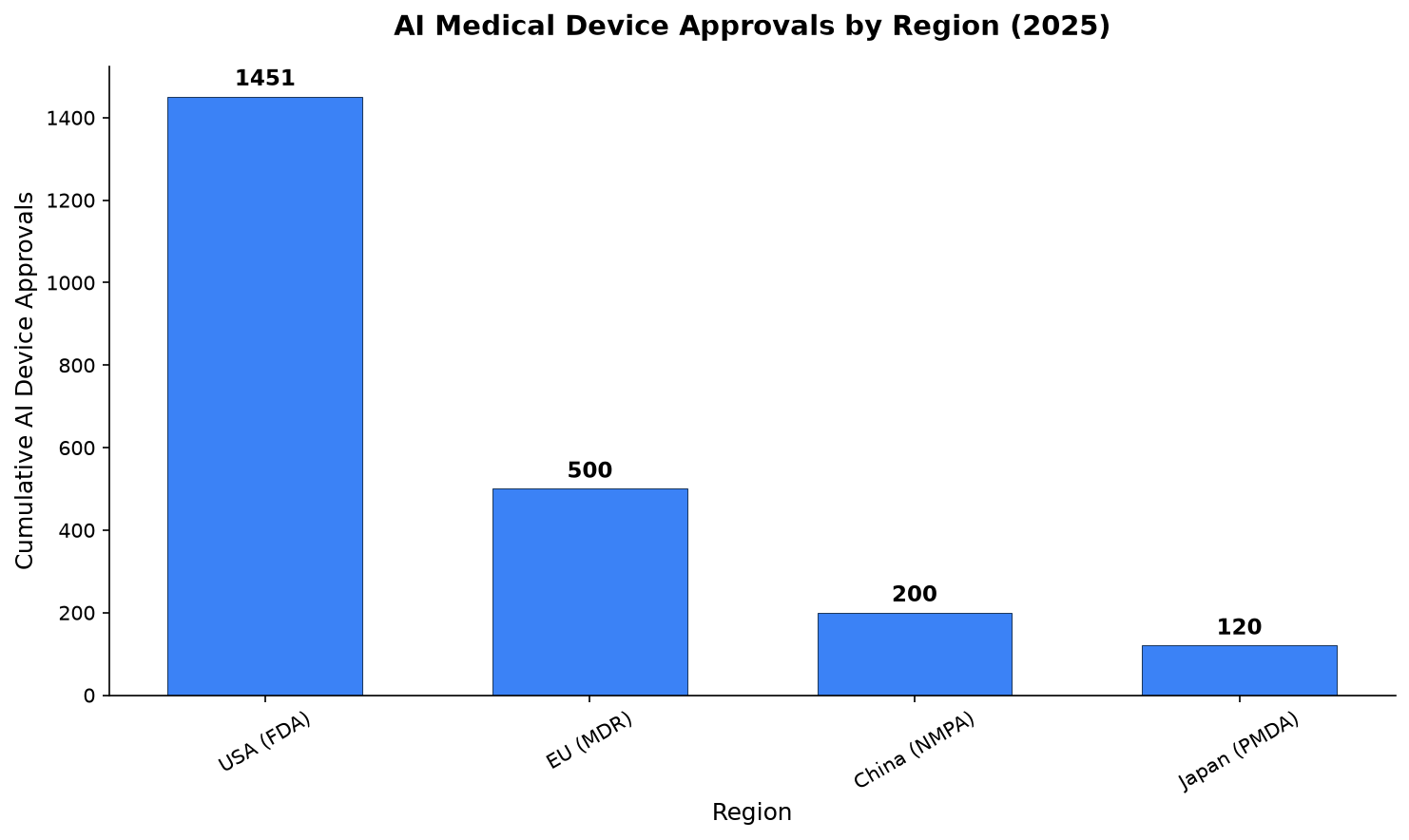
China is scaling AI in healthcare at a pace that rivals the US, with more than 200 NMPA-cleared AI medical devices. Chinese AI developers benefit from larger training datasets — China’s centralized healthcare system produces data volumes that US institutions cannot match due to fragmented record-keeping and HIPAA constraints. However, questions about data quality, algorithmic transparency, and international trust remain unresolved.
What Is the Outlook for AI in Healthcare in the Second Half of 2026 and Beyond?
Three developments will shape the remainder of 2026 and set the trajectory for 2027: the full enforcement of the EU AI Act for medical devices, the maturation of ambient AI documentation as a standard of care, and the emergence of multimodal AI models that combine imaging, genomic, and clinical text data in single unified diagnostic workflows.
The EU AI Act enforcement deadlines create an operational imperative for any health technology company operating in European markets. By early 2027, non-compliance penalties of up to €15 million or 3% of global turnover will apply to high-risk AI systems in healthcare. This is not a future risk — it is a compliance deadline that requires readiness work starting now.
Ambient AI scribes are on a trajectory to become the standard documentation method in U.S. healthcare within 18-24 months. With documentation time reductions of 13-16 minutes per encounter and measurable physician burnout improvements, the ROI case is stronger than for nearly any other healthcare AI application. Multiple major EHR vendors are embedding ambient scribe capabilities directly into their platforms, reducing the integration barrier that has slowed other AI deployments.
Multimodal AI represents the next frontier. Current FDA-cleared AI devices almost exclusively analyze single data types — images, text, or structured data. The next generation of clinical AI will combine radiology images with pathology slides, genomic sequencing data, and longitudinal electronic health record data in a single diagnostic inference. Google’s MedGemma, an open family of medical text and image models built on Gemma 3, points in this direction. NVIDIA’s 2026 report found that 61% of healthcare AI professionals are already planning multimodal AI projects, though only 12% have deployed them in production.
The bottom line for mid-2026: AI in healthcare has moved beyond pilots and early adopters into structured, measurable deployment — but the gap between administrative and clinical AI remains wide. Organizations that solve data governance, clinician training, and regulatory compliance will capture disproportionate value. Those that treat AI as a software procurement exercise rather than an operational transformation will fall further behind.
For a broader perspective on how AI adoption compares across all industries, see our State of AI Adoption in 2026 report. For an analysis of how AI agents specifically are transforming healthcare operations, see The State of AI Agents in 2026.