
Featured image: Three silhouettes representing different socioeconomic classes interacting with AI in different ways. Photo by fauxels on Pexels (Free to use).
In 2026, the question is no longer whether AI works. It works. The question is who gets the returns.
A software engineer paying $20 per month for ChatGPT Plus gets faster code completion and fewer context switches. A marketing director whose company spent $380,000 on an enterprise AI agent gets a 24/7 department that never sleeps. A venture capital partner who backed Anthropic at a $20 billion valuation watches it grow to $140 billion ARR — more than 2,200 times the annual subscription cost of Claude Pro.
These are not different use cases of the same technology. They are different classes of participation in the AI economy, and the gap between them is the defining economic story of 2026.
This article synthesizes data from HP, IBM, Study.com, KXN Technologies, PagerDuty, Anthropic, Robert Half, Levels.fyi, MarketsandMarkets, Battery Ventures, the Federal Reserve, and the U.S. Census Bureau to track who actually benefits from AI and who gets left behind.
What Is the AI Class Divide?
The AI class divide is the gap between how different income levels interact with AI. It is not about access to AI — nearly everyone has access to a free chatbot. It is about the depth, strategic value, and ownership of AI capabilities.
The divide maps to four distinct tiers, each separated by a fundamental difference in how AI is accessed and monetized:
Tier 1: AI Consumers (the general public). Use free or low-cost AI tools for casual tasks — drafting emails, homework help, entertainment. They are AI’s user base, not its beneficiaries. They consume the output of AI but capture none of the economic value it creates.
Tier 2: AI Augmenters (professionals and knowledge workers). Pay for AI subscriptions to boost productivity in their jobs. They capture measurable time savings and modest income gains, but every dollar they spend on subscriptions flows upward to the companies that own the models.
Tier 3: AI Deployers (businesses and management). Invest in custom AI agents, fine-tuned models, and enterprise platforms. They capture operational cost reductions and revenue growth.
Tier 4: AI Owners (investors, founders, Big Tech). Own the infrastructure, models, and equity that the other three tiers depend on. They capture the exponential returns.
The HP February 2026 survey of over 1,000 U.S. employees provides the clearest cross-section of Tier 1 and Tier 2 usage patterns. In technology companies, 88% use AI at least occasionally and 32% use it daily. In retail, 35% use it at all and only 9% daily. In education, 58% use it but just 8% daily. The gap between technology and retail — 88% vs 35% — is an AI class divide playing out in daily work.
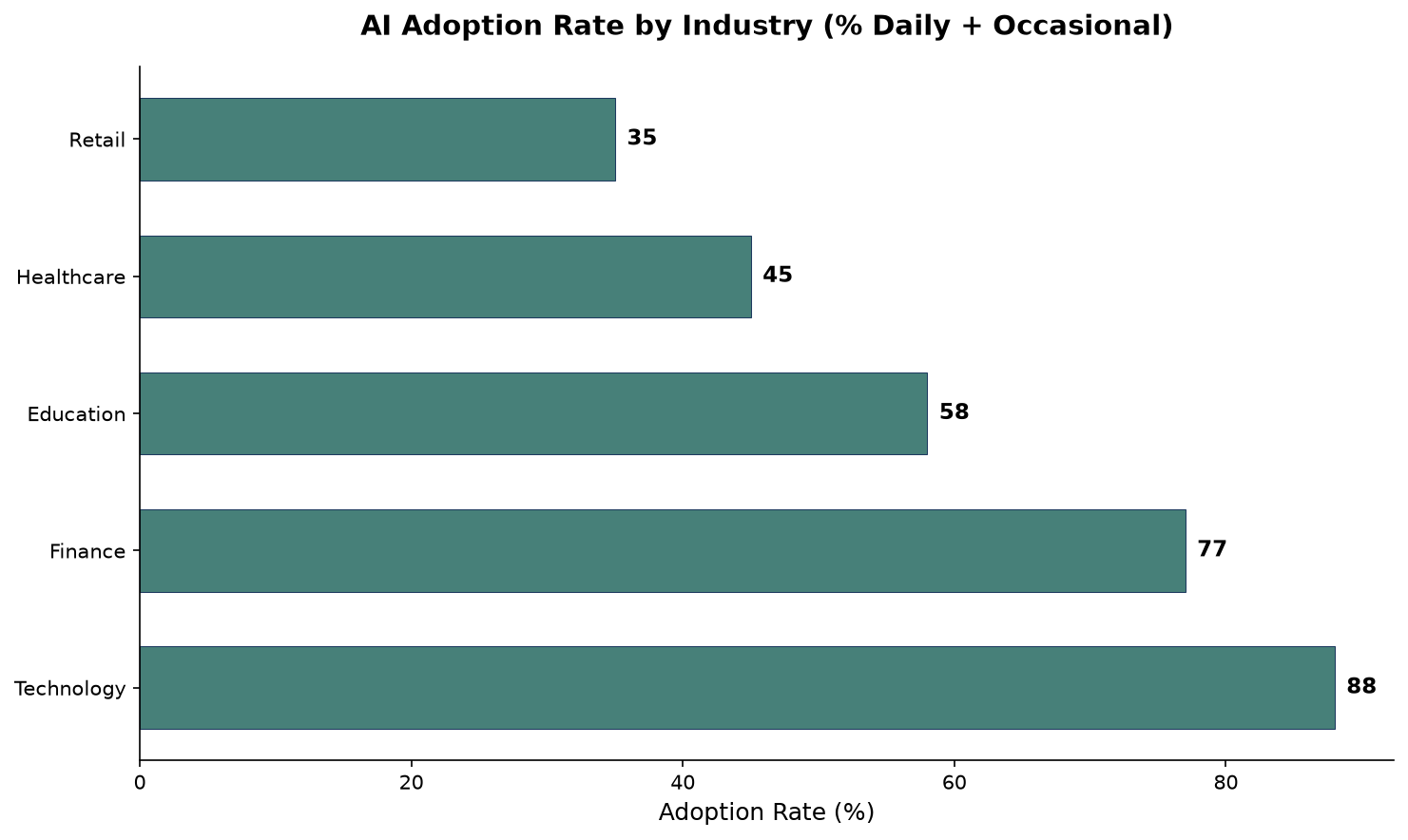
| Industry | AI Use (Daily) | AI Use (Occasional) | Never |
|---|---|---|---|
| Technology | 32% | 56% | 12% |
| Finance & Insurance | 22% | 55% | 23% |
| Education | 8% | 50% | 42% |
| Healthcare | 18% | 27% | 55% |
| Retail | 9% | 26% | 65% |
Source: HP Tech Takes survey of 1,000+ U.S. employees, February 2026. Healthcare shows 45% using AI at least occasionally; retail and education show the lowest daily engagement.
The HP survey also found that 46% of eligible workers do not use AI at all — nearly half the workforce. These are not Luddites. These are workers in sectors, roles, and income brackets where AI has not penetrated their workflow. When broken down by income, the divide becomes even starker: workers earning above $100,000 report AI usage at roughly double the rate of workers earning below $50,000. The technology that is supposed to democratize access is, in practice, being adopted first by those who already earn more.
What Does Each Tier Actually Get?
Tier 1: The Free and Low-Cost Layer
A consumer in 2026 interacts with AI through free tiers and minimal subscriptions. ChatGPT’s free tier offers GPT-4o-mini with a 128K context window. Google Gemini is free with a Google account. Claude has a free tier with limited usage.
What they get: assistance with writing emails (64% of workers, per Study.com), research help (72%), homework support, and entertainment. The HP survey confirms 46% of eligible workers never touch AI at all, meaning Tier 1 is actually split between casual users and non-users.
The economics: $0 to $20 per month. The annual cost of ChatGPT Plus ($240) represents 0.6% of a $40,000 salary. That same $240 is 0.12% of a $200,000 salary. The proportional cost is five times higher for the lower-income worker.
The returns: time savings of 10-20 minutes per day on routine tasks. No direct income gain. No equity. No ownership stake in the AI industry.
Tier 2: The Subscription Knowledge Worker
A professional in 2026 subscribes to multiple AI tools and integrates them into daily work. ChatGPT Plus ($20/mo) or Claude Pro ($20/mo), GitHub Copilot ($10/mo for individuals), and possibly Perplexity Pro ($20/mo) or Canva ($13/mo).
What they get: the Study.com survey found 72% use AI for research, 64% for email drafting, 56% for presentations. Among tech workers, 84% use AI coding tools (JetBrains via Federal Reserve). The IBM 2026 survey found 61% say AI makes their job less mundane and more strategic, and 63% would willingly work alongside an AI agent.
The economics: $20 to $80 per month in subscriptions. The IBM survey also found 56% of employees would switch employers for better AI training, and 42% would take a pay cut for it. AI-enabled freelancers earn 25% to 47% more than non-AI peers, per the Nasdaq Economic Institute.
The returns: 30-50% productivity gains on surveyed tasks. AI-enabled workers earn measurably more. But they still rent the tools — they do not own them. The distinction is critical: renting tools means the provider captures long-term margin, the worker captures temporary efficiency, and neither accumulates equity in the AI industry’s growth.
Tier 3: The Enterprise Deployer
Enterprises in 2026 deploy custom AI agents that cost $95,000 to $850,000 per deployment. According to KXN Technologies, the median first-year net saving from a single AI agent deployment is $2.4 million. Enterprises running three or more concurrent autonomous workflows report median savings above $4 million.
| Use Case | Median Year-1 Saving | Average Deployment Cost | Net Year-1 Return |
|---|---|---|---|
| Document processing | $1.1M | $380K | $720K |
| Customer service | $890K | $290K | $600K |
| Compliance automation | $780K | $310K | $470K |
| Supply chain | $650K | $420K | $230K |
Source: KXN Technologies survey of 312 enterprise AI decision-makers, Q1 2026. Net return calculated as median saving minus industry-average deployment cost.
The PagerDuty/Wakefield survey found 62% of companies expect ROI exceeding 100% on agentic AI, with an average expected return of 171%. An Anthropic/Material survey of 500+ technical leaders found 80% of organizations already report measurable ROI from AI agent investments.
The returns: 171% average ROI. $2.4M median first-year savings. These returns accrue to the company, not the individual worker. The worker using the AI tool (Tier 2) sees productivity gains; the company deploying it (Tier 3) captures the financial returns.
Tier 4: The AI Owner
The top tier is not about using AI or deploying AI. It is about owning the infrastructure that everyone else depends on.
Big Tech infrastructure spending hits $725 billion in 2026 — $310 billion from Microsoft, $175 billion from Google, $140 billion from Amazon, and $100 billion from Meta, per ValueAdd VC. These investments build the data centers, GPU clusters, and network fabric that every AI application runs on.
Anthropic’s revenue grew from $1 billion at end of 2024 to an estimated $14 billion ARR by mid-2026 — a 14x increase in 18 months, per Nevo. Claude Code alone hit $2.5 billion in annualized revenue by February 2026. OpenAI projects total sales of $125 billion by 2029, with agent revenue exceeding chatbot revenue.
The AI engineer job market reflects this concentration. Levels.fyi reports average AI engineer total compensation of $242,507 in 2026. Robert Half reports senior ML engineers earning $134,000 to $193,250 base. Data annotators, the entry-level workers who label the training data, earn $35,000 to $70,000 — a gap of 3 to 6 times.
| Role | Median Total Compensation | Divides Tiers 3 and 4 |
|---|---|---|
| Venture partner (AI-focused) | $1M+ (carry) | Owns equity |
| AI research scientist | $380K | Sells labor |
| AI/ML engineer | $280K | Sells labor |
| Data annotator | $52K | Sells labor |
Sources: Levels.fyi, Orbyt Intelligence, HiredinAI, Robert Half, 2026. The 7x gap between research scientist and data annotator is contained within Tier 4’s labor force.
The wealth creation is captured through equity. Anthropic’s early investors saw their stake multiply as the company grew from a $20 billion valuation to an estimated $90 billion+. OpenAI’s valuation reached approximately $300 billion in early 2026. The investors and founders in this tier capture returns that eclipse the combined productivity gains of all other tiers. The gap is structural, not incidental — each tier is designed by its economics to feed returns upward.
| Tier | Annual Cost | Who Pays | What You Get |
|---|---|---|---|
| 1: Consumer | $0 – $240 | Individual | Basic chatbot, email help, entertainment |
| 2: Professional | $240 – $960 | Individual or employer | Productivity tools, code assistance, research |
| 3: Enterprise | $95K – $850K | Company | Custom AI agents, RAG, workflow automation |
| 4: Owner | $100B+ (infra) | Big Tech / VCs | Equity returns, infrastructure ownership |
The gap between Tier 1 and Tier 4 is roughly 3 billion times. The gap between Tier 2 and Tier 3 — which separates the worker from the deployer — is roughly 19,000 times.
How Fast Is the Divide Growing?
The Federal Reserve’s review of 16 adoption surveys shows firm-level AI adoption at 5% to 40% depending on methodology, but all time series show rapid growth — annualized rates of 73-78% depending on the survey. The gap between those who adopt and those who do not is widening faster than any comparable technology adoption metric.
The IBM 2026 survey found that 93% of executives say they must factor AI sovereignty into their business strategy, while 56% say 56% of the workforce will require reskilling due to AI-driven automation by end of 2026. The executives planning the reskilling are not the ones being reskilled. The same survey found that 82% of executives say they need to put their best people where AI is not used to drive competitive advantage — a clear signal that even within organizations, AI creates a new divide between the “protected” and the “exposed.”
A 2025 Stripe-commissioned study found that among developers who launched a paid product independently, only 12% reached $1,000 MRR within twelve months and 3% crossed $10,000 MRR. The winners of the AI economy are concentrated at the top, just as in every previous technology cycle.
A 2025 Stripe-commissioned study found that among developers who launched a paid product independently, only 12% reached $1,000 MRR within twelve months and 3% crossed $10,000 MRR. The winners of the AI economy are concentrated at the top, just as in every previous technology cycle.
Battery Ventures found that 94% of enterprises lack a consistent AI ROI framework. Without measurement, the gains of AI flow to whoever can experiment fastest and absorb losses — which is disproportionately large enterprises and wealthy investors. The data deficit itself is a form of privilege: those who can afford to experiment without requiring proof of return are the ones who capture the upside.
What Does This Mean for the Average Person?
The honest answer is that the average person in 2026 benefits from AI modestly if they work in a knowledge-intensive role, minimally if they work in retail or service, and not at all if they work in sectors where AI has not yet penetrated. The worker earning $50,000 in retail and the executive earning $500,000 in finance both have access to ChatGPT. But the executive’s company spends $380,000 on custom AI agents that automate the processes the retail worker depends on for employment. The regulatory response to this divide — from the EU AI Act to state-level AI laws — will shape whether policy closes the gap or reinforces it.
The 46% of eligible workers who do not use AI (HP survey) are not refusing technology. They work in roles where AI has not been integrated — retail stores, construction sites, restaurants, hospitals. The 35% retail adoption rate means nearly two-thirds of retail workers never interact with AI on the job. These are the workers most exposed to AI-driven disruption yet least equipped to use it.
The IBM survey found that 48% of employees would be comfortable being managed by an AI agent. This is not enthusiasm — it is acceptance of a power shift in which workers have limited agency and limited alternatives. The same survey found 82% of executives say they need to put their best people where AI is not used to drive competitive advantage. Executives already know where AI creates value and where it does not, and the answer is not equally distributed.
The practical conclusion: AI in 2026 is not a rising tide that lifts all boats. It is a rising tide that lifts yachts, some fishing boats, and leaves anyone without a boat on the shore. The gap between $0 and $20 per month determines whether you use AI or not. The gap between $20 and $380,000 determines whether you deploy AI or compete against it. The gap between $380,000 and $725 billion determines whether you build the infrastructure or consume through it.
The data from every source in this report converges on the same pattern: the returns to AI are concentrated at the top, the tools are distributed at the bottom, and the middle — the professional who pays $20 per month for productivity — is working harder than ever to keep up. The question for 2027 is whether this divide will be addressed by policy, by competition, or by forces that no one is planning for. Either way, the gap will not close itself.