
Featured image: Abstract visualization of interconnected AI agent nodes in a digital network. Photo by Tara Winstead on Pexels (Free to use).
If 2023 was the year of foundation models and 2024 was the year of chatbots, 2026 is the year AI agents crossed from experimental technology into enterprise infrastructure. Unlike earlier AI tools that waited for human prompts, agents reason through problems, make decisions, and execute multi-step workflows autonomously. Gartner now forecasts AI agent software spending will hit $206.5 billion in 2026 — a 139% jump from $86.4 billion in 2025 — and projects $376.3 billion by 2027.
This report consolidates data from Anthropic/Material, Gartner, KXN Technologies, Grand View Research, PagerDuty/Wakefield, Microsoft, Salesforce, MarketsandMarkets, Google Cloud/NRG, Futurum, Box, PwC, and Battery Ventures to give you a single reference for where AI agents stand in mid-2026.
How Many Organizations Are Actually Using AI Agents in Production?
The headline number is that the majority of enterprises have now moved beyond pilots — but the gap between early adopters and the rest is wider than any single statistic captures.
Anthropic’s State of AI Agents report, conducted with research firm Material among 500+ technical leaders in the US, found that 57% of organizations now deploy agents for multi-stage workflows, with 16% already running cross-functional processes that span multiple teams. In 2026, 81% plan to tackle more complex use cases.
KXN Technologies surveyed 312 enterprise AI decision-makers (C-suite and VP-level) across financial services, healthcare, and manufacturing in 14 countries, and found that 67% had moved beyond pilot stage as of Q1 2026 — up from 31% in 2024. Financial services leads all industries at 74% production deployment, driven by regulatory pressure to automate reconciliation and compliance reporting.
The PagerDuty/Wakefield survey of 1,000 IT and business executives across the US, UK, Australia, and Japan reported that 51% had already deployed AI agents as of March 2025 — a figure that has almost certainly increased through mid-2026. By 2027, 86% of companies expect to be operational with AI agents.
Google Cloud’s second-annual ROI of AI study (3,466 senior leaders across 24 countries) identified a distinct group of “agentic AI early adopters” — 13% of organizations dedicating at least 50% of future AI budgets to agents — who are 88% likely to report ROI, versus 74% average.
| Metric | Value | Source |
|---|---|---|
| Enterprises in production with agentic AI | 67% (up from 31% in 2024) | KXN Technologies, Q1 2026 |
| Organizations deploying agents for multi-stage workflows | 57% | Anthropic/Material, 2026 |
| Organizations reporting measurable ROI from agents | 80% | Anthropic/Material, 2026 |
| Enterprises planning more complex agent deployments in 2026 | 81% | Anthropic/Material, 2026 |
| Organizations with agentic AI deployed (as of early 2025) | 51% | PagerDuty/Wakefield, 2025 |
| Expected to be operational with AI agents by 2027 | 86% | PagerDuty/Wakefield, 2025 |
| Enterprise apps embedding task-specific agents by end of 2026 | 40% (up from <5% in 2025) | Gartner, 2026 |
| Agentic AI early adopters seeing ROI | 88% | Google Cloud/NRG, 2025 |
What Does the AI Agent Market Size Look Like?
The market is growing at roughly three times the rate of SaaS during its hypergrowth phase. The narrow “AI agents market” — platforms and tools purpose-built for agent deployment — was valued at $7.6 billion in 2025 and is on track to reach $10.9 billion in 2026, according to Grand View Research. MarketsandMarkets projects $52.62 billion by 2030 at a 46.3% CAGR. Grand View Research is more bullish, forecasting $182.9 billion by 2033 at a 49.6% CAGR.
Regional distribution: North America holds 39.6% market share, driven by concentrated venture capital and early enterprise AI adoption among Fortune 500 firms. Asia Pacific is the fastest-growing region, driven by rapid digital transformation in manufacturing, finance, and logistics. Europe trails slightly but leads in governance requirements, with the EU AI Act creating structured compliance-driven adoption that does not exist elsewhere.
| Year | Market Size (USD Billions) | YoY Growth |
|---|---|---|
| 2023 | $3.7B | — |
| 2024 | $5.4B | +46% |
| 2025 | $7.8B | +44% |
| 2026E | $11.2B | +44% |
| 2027E | $16.1B | +44% |
| 2028E | $23.1B | +43% |
| 2029E | $33.1B | +43% |
| 2030E | $47.2B | +43% |
Sources: Grand View Research, MarketsandMarkets, HouseofMVPs compilation. Estimates converge across multiple analyst firms with minor methodological differences.
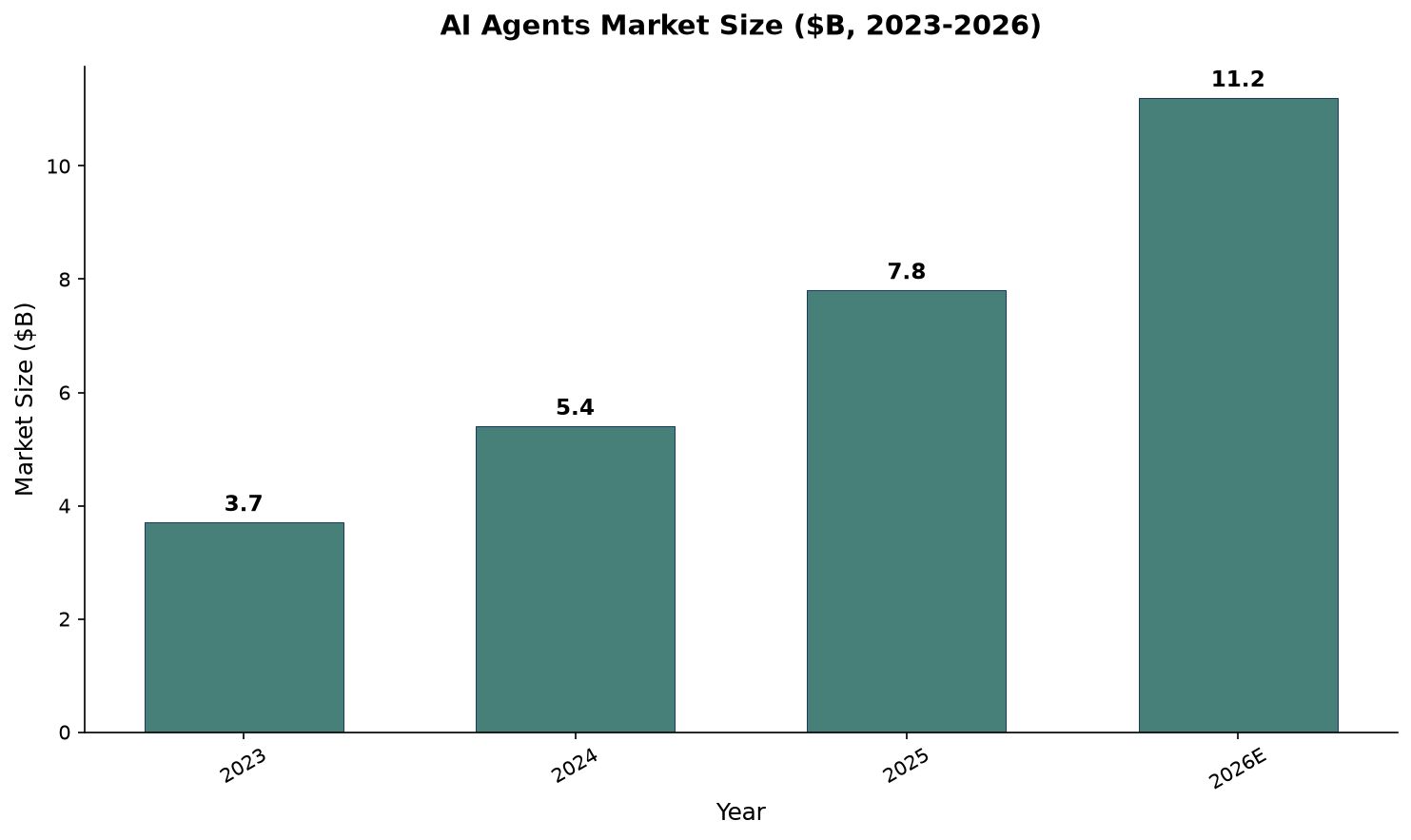
The broader Gartner figure — $206.5 billion in AI agent software spending — includes all software with agentic capabilities embedded (CRM systems like Salesforce, ERP platforms from SAP and Oracle, productivity suites like Microsoft 365), not just standalone agent platforms. This categorization captures the full economic footprint of the agent transition. The gap between $11 billion and $206 billion is the difference between “agent-native tools” and “everything that now has agent features.”
Which Industries Are Adopting AI Agents Fastest?
Financial services leads across every survey. KXN Technologies reports 74% production deployment in financial services, with compliance monitoring, fraud detection, and reconciliation as the top use cases. AgentMarketCap analysis confirms BFSI (Banking, Financial Services, and Insurance) as the largest end-user vertical at $2.4 billion in 2025 spending.
Healthcare follows at 61% production deployment, driven by clinical documentation, prior authorization, and charge capture. Technology companies reach roughly 58% adoption on production deployments, but their per-company spend is more evenly distributed across a wider range of use cases.
| Industry | Production Deployment | 2025 Spend | Primary Use Cases | Avg Deal Size |
|---|---|---|---|---|
| Financial Services | 74% | $2.4B | Compliance monitoring, fraud detection, reconciliation | $380K |
| Healthcare | 61% | $1.6B | Clinical documentation, prior auth, charge capture | $290K |
| Technology | 58% | $1.3B | Code review, internal knowledge, developer productivity | $210K |
| Retail / E-commerce | — | $0.9B | Customer service, merchandising, personalization | $95K |
| Manufacturing | 58% | $0.7B | Supply chain monitoring, QC, exception handling | $310K |
| Professional Services | — | $0.6B | Research, proposal generation, contract analysis | $180K |
| Insurance | — | $0.5B | Claims processing, underwriting, policy management | $420K |
| Government / Public Sector | — | $0.4B | Document processing, citizen services, permit review | $850K |
| Education | — | $0.3B | Tutoring, administrative workflows, scheduling | $70K |
| Real Estate | — | $0.1B | Lead qualification, property research, virtual tours | $45K |
Sources: KXN Technologies survey (production deployment — only covered Financial Services, Healthcare, and Manufacturing); AgentMarketCap / HouseofMVPs (spend and deal size). Remaining industries marked “—” lack a direct surveyed production deployment rate from available sources. Government deals are largest by size but slowest in growth; retail is fastest-growing vertical at 68% YoY.
What Are the Most Common AI Agent Use Cases?
Internal knowledge assistants dominate every survey — roughly 78% of agent deployments fall into this category. Customer-facing support agents follow at 52%, making customer experience the most common external-facing application. Engineering productivity agents reach 58% adoption.
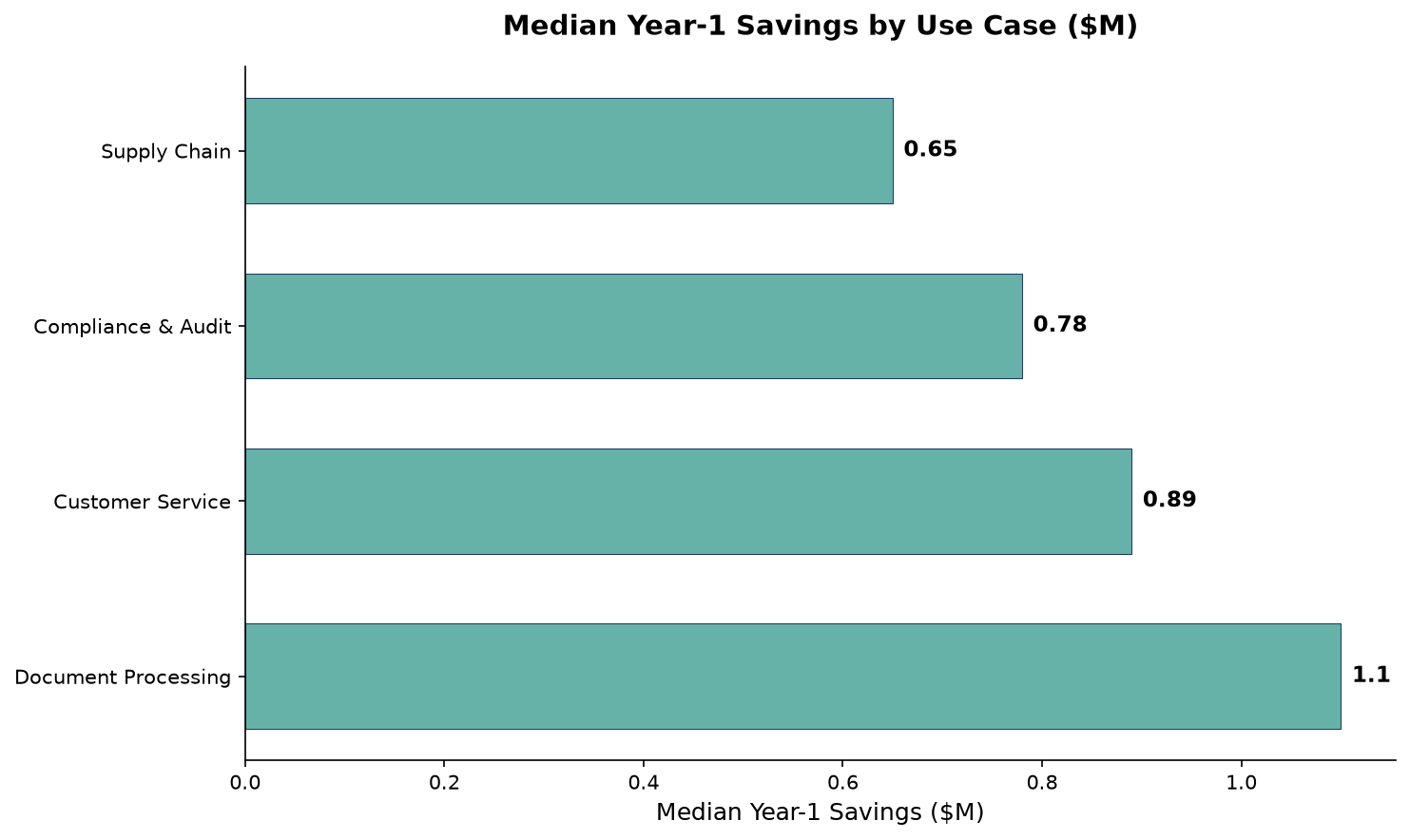
The highest-impact use cases by reported value, from the KXN Technologies survey:
| Use Case | Median Year-1 Saving | % of Deployments |
|---|---|---|
| Document processing & reconciliation | $1.1M | 38% |
| Customer service automation | $890K | 28% |
| Compliance and audit automation | $780K | 22% |
| Supply chain exception handling | $650K | 12% |
Source: KXN Technologies survey of 312 enterprise AI decision-makers, Q1 2026.
Microsoft’s public data offers a real-world scale reference: more than 160,000 organizations had deployed at least one Copilot Studio agent by May 2026, with more than 400,000 total agents in production. Salesforce Agentforce closed approximately 29,000 customer deals through Q1 2026 at approximately $800 million ARR — scaling from launch in late 2024 to a major revenue line within 18 months.
What ROI Are Organizations Seeing from AI Agents?
The short answer: the headline averages are strong, but the distribution is heavily skewed toward high-performing deployments.
Anthropic/Material reports that 80% of organizations see measurable economic returns from AI agent investments. The PagerDuty/Wakefield survey found that 62% of companies expect ROI exceeding 100%, with an average expected return of 171%. US enterprises are most optimistic at 192% average expected ROI.
KXN Technologies’ survey provides the most concrete numbers: among enterprises reporting measurable ROI, the median first-year net saving was $2.4 million. Enterprises running three or more concurrent autonomous agent workflows reported median savings above $4 million. 62% of respondents achieved full payback on implementation costs within 12 months of production deployment.
| ROI Metric | Value | Source |
|---|---|---|
| Organizations reporting measurable ROI | 80% | Anthropic/Material, 2026 |
| Median first-year net saving (all deployments) | $2.4M | KXN Technologies, 2026 |
| Median first-year saving (3+ agent workflows) | >$4M | KXN Technologies, 2026 |
| Average time to measurable ROI | 8.3 months | KXN Technologies, 2026 |
| Enterprises achieving payback within 12 months | 62% | KXN Technologies, 2026 |
| Average expected ROI | 171% | PagerDuty/Wakefield, 2025 |
| Enterprises expecting >100% ROI | 62% | PagerDuty/Wakefield, 2025 |
| Agentic AI early adopters reporting ROI | 88% | Google Cloud/NRG, 2025 |
However, the sobering counterpoint comes from Battery Ventures’ June 2026 survey of 100 senior technology leaders representing $66 billion in annual tech spend: 94% of respondents lacked a consistent enterprise-wide framework for evaluating AI ROI. Only 16% reported positive ROI on more than half their AI projects, while 31% saw ROI on less than a quarter. The gap between headline averages and typical experience is substantial enough that the OneReach 2026 Agentic AI Adoption report reframes the conversation around three-scenario ROI modeling rather than point estimates. The lesson is consistent across every data source: deployment discipline, not vendor choice, determines outcomes.
The Futurum Group’s 1H 2026 survey of 830 IT decision-makers documents a structural shift in how enterprises measure success. Productivity gains fell from 23.8% to 18.0% as the leading ROI metric. In their place, combined top-line revenue growth (10.6%) and bottom-line profitability (11.1%) now dominate — CFOs are demanding P&L accountability from agent investments.
What Is Blocking Enterprise Adoption?
The same barriers appear across every survey, ranked consistently by prevalence:
- Legacy system integration (61%). Existing IT infrastructure was not designed to expose APIs that agents can call reliably. Integration costs often exceed agent development costs.
- Data quality and governance (54%). As deployments move from structured to unstructured data, the failure rate increases. Garbage-in, garbage-out becomes an operational risk rather than a testing inconvenience.
- Explainability requirements (43%). Regulated industries need to understand why an agent made a particular decision. Black-box reasoning is acceptable for content generation but not for compliance or financial decisions.
- Internal skills gap (39%). Building and maintaining agents requires a combination of prompt engineering, software engineering, and domain expertise that most enterprises do not have in-house.
- Security and compliance approval (35%). Agentic AI introduces new attack surfaces: prompt injection, tool misuse, and data exfiltration via legitimate API calls.
Source: KXN Technologies, Q1 2026. Multiple consistent across Anthropic/Material and Gartner surveys.
Governance infrastructure has become a prerequisite for scaling beyond pilot, not an afterthought. 78% of enterprises now require human-in-the-loop validation for Tier 2 and above decisions. ISO 42001 certification — the international standard for AI Management Systems — is held by 31% of respondents, with 47% actively pursuing it, per KXN Technologies.
How Are the Major Platforms Competing?
The market has stratified into three tiers, each with a different competitive logic.
Foundation model providers build agent infrastructure. Anthropic’s Claude Code reached $2.5 billion in annualized revenue by February 2026. The Model Context Protocol (MCP) has become the de facto standard for connecting agents to external tools, adopted by Cursor, GitHub Copilot, and others. On OSWorld benchmarks, Sonnet models improved from under 15% accuracy in late 2024 to 72.5% in 2026. OpenAI launched Frontier, an enterprise platform for building and managing AI agents, and projects combined agent revenue will exceed chatbot revenue by 2029.
Enterprise platform vendors are embedding agents into existing workflows. Microsoft leads by volume: 160K+ organizations, 400K+ Copilot Studio agents, and 12M+ paid Microsoft 365 Copilot seats. Approximately 85% of Fortune 500 organizations use at least one Microsoft AI product. Salesforce Agentforce reached $800M ARR in 18 months. Agent 365 (standalone governance platform) went GA on May 1, 2026.
Agent-native startups attack specific verticals with purpose-built agents. Sierra ($150M ARR in under two years), Decagon, Cresta, and Cognigy collectively reached approximately $1.5 billion in combined ARR by May 2026, primarily in customer experience and contact center verticals. Vertical AI agents — purpose-built for legal, healthcare, or finance — are projected to register 62.7% CAGR through 2030, significantly outpacing horizontal agent platforms.
How Does Agent Adoption Compare to the Earlier Stages of Enterprise AI?
The adoption curve for agentic AI is following a steeper trajectory than either cloud computing or the early chatbot phase of generative AI.
McKinsey’s State of AI 2025 survey classified 23% of enterprises as scaling agentic AI and 39% as still experimenting. The gap between those two groups has narrowed considerably in 2026. The Box-commissioned survey found 83% of organizations running AI agents and 19% doing so autonomously at scale — a 4x increase in scaled autonomy from the prior year.
AvePoint’s State of AI 2026 report (published June 29, 2026) frames the current moment as a trust-and-control transition. The headline statistic: 97% of enterprises run AI agents but only 12% have centralized control over them — an 85-percentage-point governance gap that is wider than the equivalent gaps at the same stage of cloud adoption and SaaS adoption.
What Does This Mean for the Rest of 2026?
Three developments will define the second half of 2026.
First, the EU AI Act enforcement window opens roughly 14 weeks from this publication date, creating an operational deadline for enterprises operating agents in European markets. Compliance requirements around explainability and human oversight will force governance upgrades that many organizations have deferred.
Second, the infrastructure spending pipeline — $725 billion from Microsoft, Google, Meta, and Amazon in 2026 alone — ensures that inference costs will continue declining. Cheaper inference enables more agent steps per dollar, which directly expands the range of economically viable use cases.
Third, the measurement problem will become the central management challenge. With 94% of enterprises lacking a consistent ROI framework (per Battery Ventures), the organizations that solve measurement first will make better deployment decisions and capture disproportionate value.
The bottom line for mid-2026: AI agents are not a future trend. They are a present operational reality for the majority of large enterprises, with proven ROI in specific use cases, clear barriers that can be addressed, and a market growing at roughly 50% per year. The question for every organization is no longer whether agents will matter — it is which workflows they will transform first.